
Personal Narrative, communications assignment help
Activity 2: Personal Narrative
This assignment involves outlining, presenting and answering any five questions about your infancy, adolescence and adulthood or a combination of all three. This assignment involves answering any eight questions about your infancy, adolescence and adulthood or a combination of all three.
Build a Narrative
Humans communicate through stories. Whether they are told sitting around a fire, at a water cooler, in pictures, or in words, stories make up an integral part of our lives. While you may not automatically think of your presentation as storytelling, when you stand up in front of an audience for a period of time to share knowledge and expertise, that audience will instinctively listen for stories. Stories help us relate our different experiences and lives to each other. Told well, stories can trigger a deeper connection with an audience that ensures they will remember you and the points you want to make.
The Narrative Arc
Any type of presentation is better if it has some sort of narrative. This doesn’t always mean that you have to tell a story in the traditional sense, although relating personal stories that align to your presentation’s main point can be a compelling way to gain your audience’s interest. But even if you don’t tell a personal story, you need to think carefully about the narrative arc and the beginning, middle, and end of your presentation. Let’s take a look at the narrative arc (Figure).
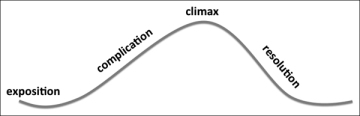
FIGURE The narrative arc
Your presentation needs to have a framework that creates clear markers for where the presentation begins (exposition), how and where the details that are generally in the middle are described (complication), where the turning point or lessons learned occurs, (climax), and where the presentation ends (resolution). This framework will provide it with natural structure, enabling the audience to follow you where you are going and to understand how you got there.
Consider how you will provide the background and description necessary to set the stage for your presentation. Think about the following questions:
- What level of detail is needed?
- How will you engage your audience’s interest in the presentation topic?
- Is there is a complicating factor, a troubling issue, or some other tricky situation that needs resolution?
- What is the climax that can serve as the presentation’s turning point, where your recommendations and their validity become clear?
Determining the benefit of your recommendations and how they can help successfully resolve a challenge will provide the audience with a satisfactory sense of completion that allows for a straightforward ending to your presentation.
Pull out the sentence you wrote earlier that defines what your presentation is about. This will help you create a clear narrative arc that stays on point and is connected to your topic. It will provide a strong common thread throughout your whole presentation that will ensure that all of your details, side points, or related stories back up that most important goal that you have committed to communicating to your audience.
This assignment prepares you to answer or ask questions and organize your thoughts in an outline format on an introductory speech about any aspects of your infancy, adolescence and adulthood or a combination of these.
|
Recall Your Infancy |
|
|
Recall Your Childhood |
|
|
Recall Your Adolescence |
|
|
As an adult |
|
NOTE: if there is any question feel free to ask because its a personal narrative
