Case Study Analysis: Recruitment and Hiring Practices

Case Study Analysis: Recruitment and Hiring Practices

This case study analysis assesses the following outcomes:

MT203-2: Examine the recruitment and selection process.

PC-4.3: Apply concepts of multiculturalism and diversity to become an agent of change.

You have read about recruiting and selection processes used in various companies as well as practiced with some of those concepts. Now you will apply your understanding of these concepts to a case scenario and then address the checklist items.

To assist you with this and other case studies in this class, a document entitled “Case Study Analysis,” is in Course Documents and can be downloaded for your reference. This document, and many other invaluable writing resources, can also be found at the Writing Center.

Case Scenario:

A Silicon Valley recruiting firm recruits artificial intelligence (AI) and technology personnel. The recruits workplace could be located anywhere the company operates, depending on their skills and expertise, although the tendency is to hire in-country nationals in each respective country. The company uses technology-oriented magazines, the company website, and social media to recruit the candidates they need for their clients. They started up about a year ago and went from 3 recruiters to 50 overnight. Their recruiters are hired for their charm, communication skills, and industry expertise, however most of the recruiters graduated from Ivy League colleges in the U.S. and most are white males. Lately recruiting numbers have been slowing down drastically while general demand in the marketplace by employers for AI and technology personnel for the coming year is up 300%.

The current recruiting practice involves hiring people via their website recruitment area. The potential candidate merely attaches their resume and includes a short note to the recruiter. These resumes are then screened using a data mining program looking for certain criteria and terminology in their resumes. Once screened, those candidates getting through the initial screening are then auto-contacted by email to tell them they need to complete the question/quiz accessed on the website using a particular password. If they pass this second screening they are given an individual interview via the company’s online conference room. Once completed, the final candidates are finally sent to the potential employer for the final interview and selection.

Now however, the president is getting complaints from the EEO Commission and the Technology firms that they need to be hiring a more diverse workforce and that there are no ADA candidates, and the number of minorities and women is almost nil. He is now worried about losing clients and potential lawsuits as a result of their recruiting and selection processes. The company needs to address a diverse client base. Their clients are Northern European, African American, Indian, and Hispanic.

Checklist: As the HR specialist of the company, you are tasked with overhauling the selection and hiring process to address the following:

  • Identify problems with the potential candidate characteristics.
  • Analyze the company’s recruitment and selection process and problems.
  • What multicultural and diversity planning concepts would you apply at the company to make a positive change?
  • Describe how you would make that positive change happen.

Access the rubric

Requirements:

  1. Use the Case Study Template (available in Course Documents) to format your paper.
  2. Complete a 2–3 page paper (not including the title and reference pages).
  3. Answer each checklist question thoroughly.
  4. Demonstrate your understanding of the information presented in the weekly reading assignments by defining terms, explaining concepts, and providing detailed examples to illustrate your points.
  5. Include at least two references from your reading assignments, or other academic sources, to reinforce and support your own thoughts, ideas, and statements using APA citation style. You can access help with APA by going to Course Resources and accessing the “APA Style Central” resources in Academic Tools.

Submit the Assignment to the Dropbox.
From Journal to Journalism: Analyzing popular descriptions of psychology or psychological research

PSY-260 Introduction to Psychological Research and Ethics

From Journal to Journalism: Analyzing popular descriptions of psychology or psychological research

For this assignment, you will find and analyze an example of popular press coverage of psychological research. You will find examples of psychological claims in advertising, magazines, the newspaper, or the Internet. Begin looking for examples now, as it may take some time to locate the perfect example. The popular source you choose has to include a psychological claim, and discuss it in some detail. You’ll have the most fun with a popular source that makes a causal claim, because you can then analyze whether the causal claim is warranted by actual experimental research. This assignment addresses the most fundamental goal of this class—becoming a better consumer of information. You will also practice your PsycINFO and APA style skills.

Your assignment is to intelligently critique the claim of the popular press coverage by using a psychology research article. Your overall goal is to use your research methods skills to answer this larger question: Is this popular source’s claim an accurate representation of the original article, or is it misleading to people?

You will need to find an article that mentions an author, institution, journal, etc., so that you can find the original article on which the popular coverage is based. Read the original source and evaluate the quality of the popular coverage. Did the journalist accurately describe the research? Did the journalist offer some advice on the basis of the study (e.g., “based on this study, you should go bungee jumping in the winter, not the summer!”)? If so, is the advice correct, or is it based on some misinterpretations of the study? For example, many journalists or advertisers may report a correlational study, but then give advice based upon the misinterpretation that correlation equals causation, which it does not (e.g., “kids who take piano lessons do better in school! So sign your kid up now!”). Or they may not report that the study was based upon a very particular population (e.g., rats), and, therefore, may not be applicable for their readers (e.g., teenagers).

You will turn in three parts:

a copy of the popular source,
a copy or PERMALINK of the psychological article you used , and
a 750-1,000-word typed report that analyzes the journalism article and the original article.
Your report should have the following components, in this order. Please use headings to separate the different sections.

A short summary of the journalist’s story, and a short introduction to the paper’s topic and this assignment. Identify and classify any claims
(frequency, association, causal) that the journalist makes in a headline or in the body of the text.

A short summary of key aspects of the original journal article: Was the study correlational or experimental? What were the main variables? What was the key finding or findings? What theory do the findings support?
An analysis of how well the journalist covered the journal article. In this section, try to make at least three significant points
What did the journalist get right?
What did the journalist get wrong, and why?
What might the journalist have said differently?
Were any causal claims made by the journalist accurate? (Apply the three causal rules!)
Did the journalist focus on the same key finding as the scientists did?
Did the journalist accurately describe the procedures of the study?
Did the journalist leave details out?
Rephrase or rewrite parts of the journalist’s article to be more accurate, if appropriate.
Prepare this assignment according to the guidelines found in the APA Style Guide, located in the Student Success Center. Include a properly formatted reference page and in-text citations.
This assignment uses a scoring guide. Please review the scoring guide prior to beginning the assignment to become familiar with the expectations for successful completion.

Mia attended a seminar about personality testing for applicants

Mia attended a seminar about personality testing for applicants. She wants you to implement one for the front bakery customer service reps. Do you think this is a good idea? Why, or why not?

Explain why an on-boarding process needs to be created. Then create an outline of an on-boarding process. Include a brief explanation of each step and explain why it is important.

In this assignment, you will create an outline of an onboarding process. Summarize what you feel are the 2 most important elements in onboarding in the global environment.

Write a one to two (1-2) page memorandum to your Human Resource Director in which you:

  1. Explain why an on-boarding process needs to be created. Then create an outline of an on-boarding process. Include a brief explanation of each step and explain why it is important.
  2. Summarize what you believe are the two (2) most critical elements to consider when on-boarding in the global environment.
  3. Format your assignment according to the following formatting requirements:
    1. Typed, double spaced, using Times New Roman font (size 12), with one-inch margins on all sides.
    2. Include a cover page containing the title of the assignment, your name, your professor’s name, the course title, and the date. The cover page is not included in the required page length.
    3. Use the APA format to reference your work, including in-text references when necessary.See the APA Guide located in the Student Center tab.

The specific course learning outcomes associated with this assignment are:

  • Analyze international business strategy to identify human resource requirements and formulate supporting HRM plans that can improve productivity and contribute to the firm’s competitiveness.
  • Select performance management processes to assess and improve performance throughout a multinational corporation.
  • Propose training programs to improve performance throughout a multinational corporation and address the considerations for effective learning in a diverse workforce of expatriates, host country nationals, and third-country nationals.
  • Use technology and information resources to research issues in global HRM.
  • Write clearly and concisely about global HRM using proper writing mechanics.

Discussion Board

Discussion Board: No APA format required, min 200 word response.

Over the last 50 years, the United States labor economy has changed from a manufacturing to service and technology focus. Other than the obvious changes, such as fewer mine tragedies and more carpal tunnel syndrome, what other trends in employment safety do you predict, and what is your evidence for that prediction? How should companies respond? How would you respond? Why?

Training Needs Assessment Exercise

Training Needs Assessment Exercise

Instructions: Read the Grand View Grocers Corporation case.

Grand View Grocers Corporation, headquartered in Clewiston, Florida, is among the nation’s top grocery chain companies, with over $34 billion in revenue. It operates and owns approximately 1,500 grocery stores in 10 states and will be expanding operatons to Washington, D.C. in the near future.

Grand View Grocer’s Corporation’s operating strategy distinguishes it from other grocery chain companies. Each grocery store has a Training and Development Methods manager that allows decisions to be made locally, close to the client. This also makes Grand View Grocer Corporation’s service more responsive, reliable, and empathetic to its customers.

Recently, Grand View Grocers Corporation has identified a that there is an increase in the annual turnover rate for cashiers nationwide.  The increase was found in newly hired cashiers, so it was determined that on-the-job training was ineffective.

Under the direction of the store manager, cashiers perform a variety of tasks, including:

·         Receive payment by cash, check, credit cards, vouchers, or automatic debits.

·         Issue receipts, refunds, credits, or change due to customers.

·         Count money in cash drawers at the beginning of shifts to ensure that amounts are correct and that there is adequate change.

·         Greet customers entering establishments.

·         Maintain clean and orderly checkout areas.

·         Establish or identify prices of goods, services or admission, and tabulate bills using calculators, cash registers, or optical price scanners.

·         Issue cashier’s checks, money orders, mailing stamps, and redeem food stamps and coupons.

·         Resolve customer complaints.

·         Answer customers’ questions, and provide information on procedures or policies.

·         Cash checks for customers.

·         Weigh items sold by weight in order to determine prices.

·         Calculate total payments received during a time period, and reconcile this with total sales.

·         Compute and record totals of transactions.

·         Sell lotto tickets and other items to customers.

·         Keep periodic balance sheets of amounts and numbers of transactions.

·         Bag, box, wrap, or gift-wrap merchandise, when needed.

·         Sort, count, and wrap currency and coins.

·         Process returns and exchanges.

·         Request information or assistance using paging systems.

·         Stock shelves, and mark prices on shelves and items, when needed.

·         Compile and maintain non-monetary reports and records.

Essential cashier functions include the following:

  • Perform for or Working Directly with the Public — Performing for people or dealing directly with the public. This includes serving customers in restaurants and stores, and receiving clients or guests.
  • Establish and Maintain Interpersonal Relationships — Developing constructive and cooperative working relationships with others, and maintaining them over time.
  • Get Information — Observing, receiving, and otherwise obtaining information from all relevant sources.
  • Identify Objects, Actions, and Events— Identifying information by categorizing, estimating, recognizing differences or similarities, and detecting changes in circumstances or events.
  • Process Information — Compiling, coding, categorizing, calculating, tabulating, auditing, or verifying information or data.

Describe in 350- to 525- words the training method or combination of training methods that you would recommend for training.

Justify in 350- to 525- words your choice of method(s).

Compensation Purpose and Strategy Document

Compensation Purpose and Strategy Document

The purpose of this assignment is to choose a compensation philosophy that is appropriate for your chosen firm and articulate a rationale for this selection.

There are two aspects to this assignment. First, describe the risks and benefits with leading, meeting, and lagging the market in overall compensation and benefits. Next, choose the appropriate strategy (lead, meet, or lag) for your firm, and provide rationale about why this is appropriate.

There is a minimum requirement of 500 words for the compensation purpose and strategy document.

Consider some of the following factors in your assignment:

  1. Payroll expenses are usually the highest expense at most firms. If you lead the market, this expense can be taxing.
  2. If you are pursuing top talent in human capital rich industries (e.g., software engineering), lagging the market may keep you from competing for market share against your competitors.
  3. If you meet the market, paying average will generally not attract top talent, and in addition, you will not have the labor-cost savings of a lag-the-market strategy.

Any sources used, including the textbook, must be referenced; paraphrased and quoted material must have accompanying citations in APA format.

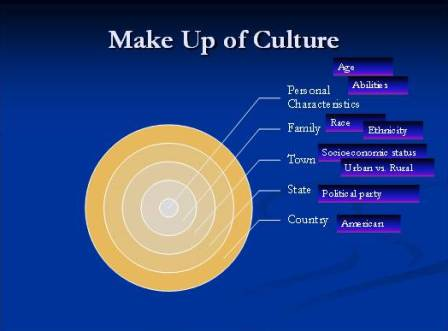
Which of the cultural phenomena shown best defines your cultural identity?

In this weeks chapters we reviewed important concepts in providing sensitive, effective care to clients from other cultures. The concept of world view and characteristic beliefs or behaviors were described. Information about the culture of medicine and the values and beliefs that we accept as we acculturate as a health care professional was presented.Based on the framework shown here:

Which of the cultural phenomena shown best defines your cultural identity?

What nationality/ethnicity/culture does your last name represent?

In what ways do you identify with that culture, if any?

Are there any aspects of that culture that you have consciously chosen to reject?

Directions attached 1

You must use a citation and reference

Required Textbook: Psychosocial Aspects of Health Care, 3rd edition Publisher: Pearson Education Authors: Drench, Noonan, Sharby and Ventura ISBN: 978-0-13-139218-2

You work for Google as an HR General, and determine the necessary components to an attractive compensation plan.

Scernio:

You work for Google as an HR General, and determine the necessary components to an attractive compensation plan.

Write a five to seven (5-7) page paper in which you:

1.       Briefly describe your position as HR Generalist with Google.

2.       Create a rewards and compensation package for this position that would attract skilled workers, yet control costs at the same time.

3.       Create a benefits package for this position that is competitive, yet advantageous to the company.

4.       Speculate on how the negotiating and collective bargaining of this specific position would contribute to the achievement of organizational goals. Provide a rationale for your response.

5.       Use at least five (5) quality academic resources in this assignment. Note: Wikipedia does not qualify as an academic resource.

6.  THIS IS FOR AN ORGINAL UNUSED NOT PREVIOUSLY PUBLISHED PAPER WITH LESS THAN 15% PLAGARISM AS IT GO THRU A CHECKER. 

Your assignment must follow these formatting requirements:

·         Be typed, double spaced, using Times New Roman font (size 12), with one-inch margins on all sides; references must follow APA or school-specific format. Check with your professor for any additional instructions.

·         Include a cover page containing the title of the assignment, the student’s name, the professor’s name, the course title, and the date. The cover page and the reference page are not included in the required page length.

The specific course learning outcomes associated with this assignment are:

·         Assess the effectiveness of human resource planning and performance management systems.

·         Assess how negotiating and collective bargaining contribute to the achievement of organizational goals.

·         Use technology and information resources to research issues in employee and labor relations.

·         Write clearly and concisely about employee and labor relations using proper writing mechanics.

What beliefs or behaviors do you see that are different than your own?

Respond to this with your thoughts and opinions.  APA

What beliefs or behaviors do you see that are different than your own?

Britain has a similar style of caring for the elderly as the United States apart from universal healthcare. I feel that the elderly in Britain are better cared for because they do not have the gaps in coverage that are left from Medicaid and private insurance policies. Universal health care ensures that chronic problems are identified and managed from an earlier stage of disease allowing elder British citizens to remain more independent for longer periods of time. In My Generation, Tim Samuels portrayed the feelings of an aging generation who felt left behind and forgotten (Samuels, 2017). I feel that American and British elders can mirror the sentiments regarding long term care plans.

The Grey’s Anatomy Hmong episode demonstrates the greatest differences between my personal individualistic culture and collectivist mindset of the Hmong people. In the episode the Hmong family feels that the patient has become ill due to a wandering soul (Eyerly, 2018 ). Initially McDreamy and Meredith do not understand the refusal of treatment and continue to insist on surgical treatment using Western reasoning. It is only when the family is separated do they feel comfortable enough to answer questioning about their cultural beliefs. Anna, the daughter, explains that she respects her elders more than her own autonomy. She trusts her Father’s assessment regarding a wandering soul and respects his decision to refuse surgery (Eyerly, 2018 ).

Derek questions Anna’s father in an attempt to understand the cultural beliefs of the Hmong people. Derek asserted his position as a caregiver and surgeon explaining that Anna could meet with the family shaman in the hospital. Derek showed cultural competence when he chose to collaborate Eastern beliefs with Western medicine.

 How would you feel if this person were your client, or how would you feel if you worked in this environment?

As an imaging professional in a hospital setting it is not uncommon to see patients who present with severe clinical symptoms whom refuse treatment. I understand Derek and Meredith’s frustration when a patient is willing to leave against medical advice or refuses treatment. It is easy to think, why come to the hospital if you don’t want our help?  Most often, truly ill patients have a belief system that is preventing them from accepting the treatment they desire. It is important to take a step back and consider that the patient may not have the same beliefs or point of view (Drench, Cassidy Noonan , Sharby , & Hallenborg Ventura, 2012). Cultural competence can ease the tension in these situations through an open dialogue of questions.

All the drama of a typical Grey’s anatomy aside, Derek resorted to cultural competency after his standard bedside manner failed. His initial attempts to convince the family fell short because he was not considering Hmong beliefs. Derek changed course once he understood that the family respected his diagnosis but was refusing on religious grounds. Cultural competency training tells providers to forego assumptions and ask if there are any religious or cultural needs. My hospital does its best to provide the patients with a variety of on call religious services as well as a program that prevents patients from dying alone. Derek realized his mistaken assumptions that the family did not understand the severity of Anna’s condition and provided the family with the cultural considerations that were best for Anna’s care. In the end cultural competency won out and provided Anna with the care she needed which would have made me proud of the care team.

There is always room for improvement and I feel that if this situation were real it would be an important learning example for our regular Friday updates or quarterly meetings. I find that the best examples are relatable and create learning experiences through association.

• What questions could you ask to help this person to feel most comfortable in your clinical setting?

I believe that Derek and Meredith eventually asked the right questions. The most important question to ask is what the patient would like us, as caregivers, to know about their culture or health preferences (Drench, Cassidy Noonan , Sharby , & Hallenborg Ventura, 2012). In addition, providers who are met with refusals for care should ask the patient why they feel the need to refuse, and who typically makes health care decisions for them. A third important question to ask is what intentions the patient had, or what goals they expected to be met when they came to the hospital. Asking these questions is only the beginning to making the person feel comfortable. Providers should ask follow on questions to make sure they are clear about the expectations and goals of the client. Having the right answers gives the care team the ability to accommodate requests such as opening the window to let a soul out upon death, or restorative foods for yin and yang imbalances.

• Do you think the elderly are mistreated in our society? Our health care system?

I believe that the elderly are especially susceptible to mistreatment and abuse in society and in the health care system. Long term health systems were designed to support the needs of an aging population especially with the population explosion that came from the baby boomer generation. Social Security and Medicaid are the most common programs that aging Americans rely on. Unfortunately, many of these systems have been exploited through underfunding and government cut backs.

In addition to dwindling government resources American employers have stepped away from pension systems into self-funded retirement plans. Self-funded retirement plans are more flexible and reliable than pensions, however, they only recently became wide spread during the 1970’s. Modern medicine has increased the lifespan of the silent generation and baby boomers beyond the support of financial retirement preparation. The combination of scarce financial resources and extended life spans the elderly have become increasingly vulnerable to abuse and mistreatment.