power of Love and Relationship, assignment help

Power
of Love and Relationships

For
this assignment, please address each of the items below:

1. Describe
the factors of attraction. What attracts us to one another? Why are
we less likely to befriend someone from another culture than someone
from a similar background with a similar physical aesthetic? Be sure
to identify and describe all six factors in attraction.

2. Discuss
the human need to build bonds and relationships. Do we have an innate
need to belong? If so, why? How is this need attached to our
emotions, our social bonds, and our fear of
deprivation? 

3. Explain the three types
of love: companionate, passionate, and compassionate.  What are
the differences and similarities among them? What is an example of
each type? How does Sternberg’s Triangular Theory of Love
distinguish romantic love, from empty love or infatuation? Please
thoroughly address each of the components in Figure 12.1. 

Include
an introduction, thesis statement, and conclusion. Your completed
assignment must be three to four pages in length (excluding title and
reference pages).  It must include a minimum of two to three
references, formatted according to APA guidelines, as outlined in the
Ashford Writing Center

Figure12.1: Sternberg’s triangular theory of love
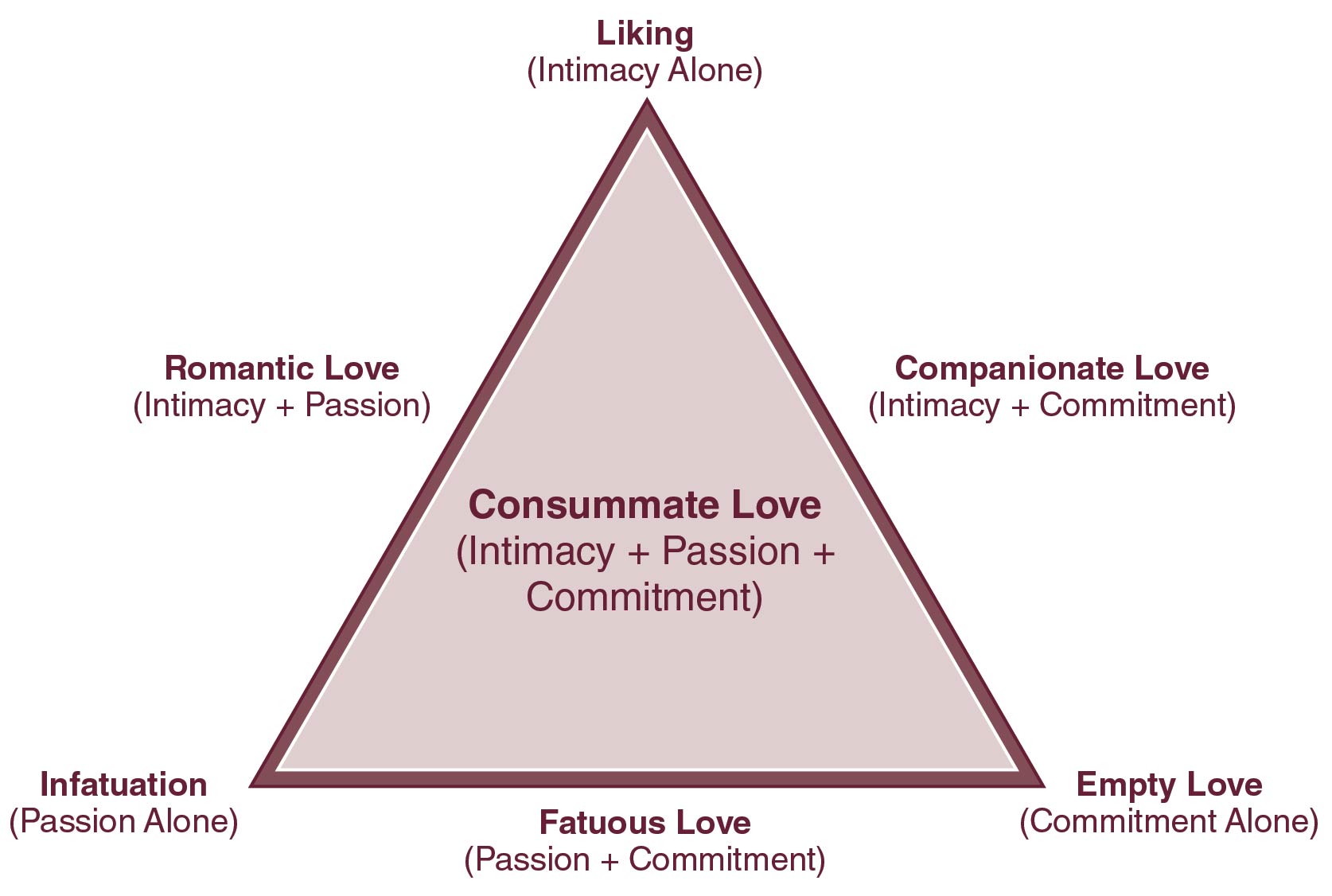
Illustration showing the types of love according to Sternberg's theory. The illustration is made up of one pink triangle. The only label contained within the triangle is "consummate love (intimacy plus passion plus commitment)". The rest of the labels are on the outside of the triangle. The top point is labeled "liking (intimacy alone)." The bottom left point is labeled "infatuation (passion alone)." The left side of the triangle between these points is labeled "romantic love (intimacy plus passion)." The bottom right point is labeled "empty love (commitment alone)." The bottom side of the triangle (between the bottom left and bottom right points) is labeled "fatuous love (passion plus commitment)." The right side of the triangle (between the top point and bottom right point) is labeled "companionate love (intimacy plus commitment)."

Discuss when the direct-approach message structure may be inappropriate. Give specific examples.

Module 4.1: Direct Approach

In memos, letters, or emails, you have to organize your writing so that it efficiently communicates your message. Usually, the direct approach is most effective.

The Direct Approach

In the direct approach, you present your main idea first (See pages 59-60 for a review).

Main Idea First: To save time and prioritize, business readers usually want to to know your main point immediately, so explain your purpose for writing in the first few lines to let them know why they should keep reading.

The textbook divides common message types into requests and replies:

  • Requests for information or reader action should begin with the main idea that the writer is communicating to the reader — a brief statement of the request.
  • Replies answer requests for information or action. Always include a clear and specific subject line, and open by reminding the reader of their original request to you. Openings might include: “As you requested…”, or “In response to your request…”. If the requester wrote several people or some time ago, they may not immediately remember why they wrote to you.

Now, please review the examples:

  • Direct Replies in Figure 7.5 in the text
  • Direct Request, Figure 7.1 and 7.2 in the text

Details Follow: The middle paragraphs provide specific details, facts, and figures, and develop the idea further. Ensure you provide all the details the reader needs to understand your message and to make an appropriate decision. Prioritize details and present the most important ones first.

Use graphic highlighting, such as lists, headings, etc., to emphasize important information. Make your document easy to scan, but don’t just note ideas in point-form. Most paragraphs should offer thoughts in complete, coherent sentences, and lists should have a proper lead-in.

Finally, Action: This last paragraph describes the next step to be taken by the reader. If you want a specific action taken, state exactly what that action is, when it needs to be done and why. People are more likely to comply if given a deadline and logical reasons for the deadline and/or action, especially if those reasons are benefits to them (yes, the “you approach” again!).

If you don’t require your reader to take specific action, you can finish with an invitation for feedback or questions. These conventional endings aren’t required, but provide closure and convenient contact information for questions or clarification.

Personalize your ending with specific details. Don’t use a generic closing expression. Avoid cliched, over-used, or old-fashioned phrases like “feel free”, or “at your earliest convenience”.

  • “Please contact me at yourname@email.com or (123)456-7890 if you have any questions about the implementation of Project X.”
  • “Please contact me before our next project meeting on Friday if you have any proposed changes to this budget or need further details.”
  • “I would appreciate your feedback before our next project meeting on September 5. I will call you next week to arrange a meeting.”

chapter review and questions

Part one: Chapter 12 – Death and Dying By Stephen Hunt Chapter Summary.

“Death and Dying” by Stephen Hunt Ch.12

Summarize with an in-depth study 300 word reaction to the reading. Please make sure that you post at the end at least 2 and preferably 3 ‘provocations’ (i.e. provocative questions triggered by your reading).


Part Two: Chapter 12 – Death and Dying Questions.

after reading chapter 12, Answer EACH question in one paragraph of at least 100words. At the end of this exercise, you will have 3 well-developed paragraphs with no less than 300 words.

1. Explain the Freud’s two central desires of Thanatos and Eros and what are the main points of these desires.

2. How is death perceived in the western societies in comparison to poorer and less developed countries?

3. Explain the afterlife views of the Seventh-day Adventist, Catholic, and Hindu religions.

Help writing a paper

Paper assignment directions: Write a five page paper on Abortion. The paper does not need to involve special library or internet searches beyond the attached annotated bibliography. Expand on the attached annotated bibliography. Be sure and address the following items in the paper: 1. What is the issue? 2. How does it relate to the class? (American Government) 3. Who are the interest groups related to the issue? 4. What does your research tell you about the issue? 5. What is your opinion on the issue and has it changed? In this last section # 5, my opinion hasn’t changed. I’m a conservative and I’m pro-life. In summary, I believe every human being from its conception has the right to live. I think exception would be in the cases of rape, incest or when the mother’s life is in danger. See attachments for details.

Eng 102 week 4

Your initial thread should be three paragraphs in length (200+ words) and provide textual evidence. You should provide at least one direct quote from the source formatted in MLA Style.

You will identify symbolic elements within “The Lottery” by Shirley Jackson and “Bartleby, the Scrivener” by Herman Melville. As you reflect upon the symbolism, strive to go beyond objects. Keep in mind that symbols do not always refer to objects, but characters, settings, and events can also function symbolically. Identify at least one symbol in one of these stories, and address the following questions for each symbol you discuss:

  1. Describe the symbol itself. Where does it appear in the story?
  2. What is the significance in the story of the symbol?
  3. What does this person, setting, or object symbolize?
  4. What is the author’s purpose in including this symbol in the story?

busines seminar case analysis

Walk into an IKEA store anywhere in the world, and you would recognize it instantly. The warehouse-type stores all sell the same broad range of affordable home furnishings, kitchens, and accessories. Most of the products are instantly recognizable as IKEA merchandise, with their clean yet tasteful lines and functional design. The outside of the store will be wrapped in the blue and yellow colors of the Swedish flag. The store itself will be laid out as a maze that requires customers to walk through every department before they reach the checkout stations. Immediately before the checkout, there is an in-store warehouse where customers can pick up the items they purchased. The furniture is all flat, packed for ease of transportation, and requires assembly by the customer. If you look at the customers in the store, you will see that many of them are in their 20s and 30s. IKEA sells to the same basic customers all across the world: young, upwardly mobile people who are looking for tasteful yet inexpensive “disposable” furniture. A global network of about 978 suppliers based in 50 countries manufactures most of the 12,000 products that IKEA sells. IKEA itself focuses on the design of products and works closely with suppliers to bring down

manufacturing costs. Developing a new product line can be a painstaking process that takes years. IKEA’s designers will develop a prototype

design—a small couch, for example—look at the price that rivals charge for a similar piece, and then work with suppliers to figure out a way to cut prices by 40 percent without compromising on quality. IKEA also manufactures about 10 percent of what it sells in-house and uses the knowledge gained to help its suppliers improve their productivity, thereby lowering costs across the entire supply chain. It’s a formula that has worked remarkably well. From its roots in Scandinavia, in 2015 IKEA had grown to become the largest furniture retailer in the world with 328 stores in 28 countries and revenues of $36 billion (32 billion euro). IKEA had 771 million store visits and 1.9 billion online visits (IKEA.com). With its Swedish heritage, IKEA is particularly strong in Europe, where it has more than 200 stores, but it also has around 50 stores in North America. Its strongest growth recently has been in China, where it had 17 stores, and Russia, where it had 14 stores. Look a little closer, however, and you will see subtle differences between the IKEA offerings in North America, Europe, and China. In North

Chapter Twelve The Strategy of International Business 353

354 Part Five The Strategy of International Business

America, sizes are different to reflect the American demand for bigger beds, furnishings, and kitchenware. This adaptation to local tastes and preferences was the result of a painful learning experience for IKEA. When the company first entered the United States in the late 1980s, it thought that consumers would flock to their stores the same way that they had in Europe. At first they did, but they didn’t buy as much, and sales fell short of expectations. IKEA discovered that its European-style sofas were not big enough, wardrobe drawers were not deep enough, glasses were too small, and kitchens didn’t fit U.S. appliances. So the company set about redesigning its offerings to better match American tastes and was rewarded with accelerating sales growth. Lesson learned, when IKEA entered China in the 2000s, it made adaptations to the local market. The store layout reflects the layout of many Chinese apartments, where most people live, and because many Chinese apartments have balconies, IKEA’s Chinese stores include a balcony section. IKEA has also had to shift its locations in China, where car ownership lags behind that in Europe and North America. In the West, IKEA stores are located in suburban areas and have lots of parking space. In China, stores

are located near public transportation, and IKEA offers a delivery service so that Chinese customers can get their purchases home. Sources: J. Leland, “How the Disposable Sofa Conquered America,” The New York Times Magazine, October 5, 2005, p. 45; “The Secret of IKEA’s Success,” The Economist, February 24, 2011; B. Torekull, Leading by Design: The IKEA Story (New York: HarperCollins, 1998); P. M. Miller, “IKEA with Chinese Characteristics,” Chinese Business Review, July–August 2004, pp. 36–69.

CASE DISCUSSION QUESTIONS 1. Why do you think IKEA uses a floorplan that “forces” the customers to move along a certain path in the store? 2. Is it appropriate for IKEA to customize their furniture to each geographic location, for example, differences between U.S. and European furniture? Some companies do not make these changes, but IKEA does; why?

week 5 discussion questions

Discussion Questions: Please answer the following two questions separately. Quoted material is not allowed. Please write the answer in your own words. 

1.Companies have a significant amount of investment in long-lived assets, which include property, plant and equipment (commonly referred to as plant assets), and intangible assets.Let’s begin by talking about plant assets. Can you tell us what kind of plant assets are used in your company or place of business? Do you have an estimate of the amount invested in those plant assets?

2. Why are liabilities classified on a balance sheet as current and noncurrent? Who wants to know? What is the benefit of knowing this information?

Reflection question: please write reflection on the following students’ post separately. 

Student A: 

Many years ago I worked at a bowling alley and amusement center in Newport, Rhode Island. I worked there during the era when manual scoring was replaced by the computer scoring monitors. While there is the obvious building, lanes, pin re-setting and ball return plant assets, these computer monitors became one of the more expensive assets for the center. During the 1990’s the technology was poor and the accuracy was even poorer. However, with the addition of these monitors, business readily increased. While I have no idea how much they cost, I know that they were a substantial investment for the business. It did prove to be a wise investment, because scoring bowling can be complicated for those that just want to throw a ball down the lane, maybe get more pins knocked down than beers. Computers are almost standard equipment at bowling alleys at this point.

Student B: 

Plant assets like everyone else has identified are long-lived assets that are tangible such as land, buildings, and equipment. The expense that is associated with plant assets is called depreciation. I work for a large company so to estimate how much we have invested in plant assets is going to be a bit of a SWAG. To begin with even though we are a large company to save on costs the company doesn’t have a lot of plant assets because we are primarily a service-based company. The plant assets we do have are office furniture, and office signage. The company support government contracts and expenses any equipment that is needed for a contract to the government. The company also leases the buildings it needs to support government contracts. It does not make sense for a company to build their own warehouses or office building because most contract only last 3 – 5 years and there are no guarantees that the incumbent will keep the work. If the work is lost the leases for building are often transferred to the new company.

The office I work out of is 14,000 square feet with 75 workstations. I would estimate our furniture assets at approximately $20k when it was new.

Student C: I think the reason to classify the liabilities two different kinds are to differ between the obligation that are reasonably expected to be liquidated in less than one year. and the others which are the obligation whose settlement due extends beyond one year. 
we could know the differences by how long to be expected to be liquidated, below one year or more than one year.

Knowing the difference is so important since the current liabilities are due to below of one year and that would affect the cash and other assets that could be liquidate and to be transferred to cash in one year. 

oftware developer for a small company, Writing Assignment Homework Help

You are working as a software developer
for a small company developing learning materials which you put into a learning
management system for use in online learning environments. Your clients are
colleges which provide services to students in schools all around the world.
One of your clients works with children with disabilities. You are working on
material which is to be used by children in hospital and rehabilitation who
have suffered trauma through an accident. These children live all around
Australia, in country areas and in city facilities. The sorts of injury they
have suffered include loss of sight, partially and fully blinded, limited body
movement including loss of the use of their hands.

What are some of the issues you will have to think about as you design and
implement your software to support your client and their students?

The prompt in this assignment is based on the video or the article. Either may be used for this essay.

https://www.nytimes.com/2018/11/30/us/tm-landry-co…

The prompt in this assignment is based on the video or the article. Either may be used for this essay.

In one to two well reasoned, good length paragraph(s), discuss the possible racial discrimination, if any, you find that exists at the school. If you find no discrimination, discuss why you don’t believe there is any. Your discussion must be supported by at least one text reference. The text reference must be to page number and edition. You may present your opinion but there must be some support from the material in this class. This is not about YOUR college campus but the Landry’s school.

Do not approach this assignment thinking that there is one chapter in the text that you can use in your discussion. It is wide opened! If you believe there is discrimination, describe it. But, you describe/discuss it in the context you choose. Is there an ethical issue? Or, maybe a tort or crime? It could possibly be a violation of the Civil Rights Act or the Constitution? It is possible you don’t see anything with the Landrys that raise any issues. Then go with that and, using any legal concept, say why not. Just remember to support your opinion with a text reference that is a page number and textbook edition.

There is no right or wrong answer. Can you follow instructions and use your critical thinking skill to produce a credible answer is the goal:)

If you use a resource that is not the text, it will be counted as using no text reference.

Paragraph(s) content 5 points

Text reference 1 points (Did I say this must be to page number and edition?)

Spelling/grammar 1 points.

Crime Scene Investigation, law homework help

Preliminary investigations do not necessarily yield enough information to prosecute a criminal case. Despite a thorough preliminary investigation, many cases require a follow – up investigation. Use your textbook, the Internet, and / or Strayer Library to research articles on crime scene investigation.

Write a three to four (3-4) page paper in which you:

  1. Assemble a set of guidelines on conducting preliminary investigation for a criminal case.
  2. Propose one (1) strategy that criminal investigators should take in order to conduct an efficient follow-up investigation. Provide a rationale to support your response.
  3. Select two major crimes (e.g. sudden deaths, sex related crimes) and compare and contrast the key differences in reporting the two major crimes that you selected.
  4. Determine the three (3) most important characteristics of an effective criminal investigator and discuss the importance of each characteristic you determined.
  5. Support or critique the argument that the criminal investigation process should maintain the balance regarding freedom of information through media outlets and privacy rights of alleged perpetrators of crime. Provide a rationale to support your response.
  6. Use at least two (2) quality academic resources in this assignment. Note: Wikipedia and similar type Websites do not qualify as academic resources.

Your assignment must follow these formatting requirements:

  • Be typed, double spaced, using Times New Roman font (size 12), with one-inch margins on all sides; citations and references must follow APA or school-specific format. Check with your professor for any additional instructions.
  • Include a cover page containing the title of the assignment, the student’s name, the professor’s name, the course title, and the date. The cover page and the reference page are not included in the required assignment page length.

The specific course learning outcomes associated with this assignment are:

  • Describe the major components of and responsibilities involved in the investigative process.
  • Recommend improvements to the criminal investigation process in selected areas.
  • Describe the procedures for the preparation of field notes and the documentation of a crime scene.
  • Use technology and information resources to conduct research in the criminal investigation process.
  • Write clearly and concisely about the criminal investigation process using proper writing mechanics.