Bronfenbrenner’s ecological theory

One of the important attributes of theory is the ability to help explain and predict outcomes. Within development, this couldn’t be truer. Developmental theories have helped researchers and professionals alike be able to understand how influential factors impact development and lead to positive and negative outcomes later on in life.

For this assignment, you are to select one of the provided case studies and analyze it using Bronfenbrenner’s ecological theory (revisit chapter 1). When analyzing the case study, you will address each level of the theory and indicate how factors from within the system impacted the development and outcome of the individual within the case study.

  • Microsystem: examples include but are not limited to family members, teachers, friends, and neighbors; how do these factors interact with the individual and how does the individual impact these factors?
  • Mesosystem: this level emphasizes relationships among members of themicrosystem, such as the dynamic between parents and the child’s teacher; are there dynamics that play a role in how the individual developed?
  • Exosystem: here the environment can directly influence the individual, but the individual does not have a reciprocal role; an example would be a parent’s place of employment; what factors within this system impacted the individual?
  • Macrosystem: this level reflects the cultural influences of the individual, such as their socioeconomic status (SES) or race; again, the individual may not impact this level, but this can influence them; how and why did aspects of the macrosystem impact the individual’s development?
  • Chronosystem: here the historical context and change over the individual’s lifespan can exact influence, including policy and social norms; for example, the legalization of same-sex marriage may influence an individual’s willingness to be open about their sexual orientation and seek out a family. Utilizing the individual’s age, what historical contexts may help explain the how and why of the individual’s development?

These are just some sample questions you can ask as you evaluate the individual’s development from each level of the ecological theory.

Now, the case studies are not fully complete and there are always additional factors that influence our choices and behaviors. You can speculate additional factors that are not listed, but be sure they are backed up with research and tie into ecological theory. While you can address the other family members that are listed within the vignette, the name in bold is the person of interest and whom you should center your analysis on.

Guidelines

Research will be crucial to help create your argument for why you think the case study person ended up the way that they did. You will need at least three (3) scholarly sources from peer-reviewed publications, such as academic journals, books, and textbooks. In-text citations and the reference page need to be presented in APA format.

Case Study #1

Christina (age 13, African-American) has lived with her grandmother, aunt, and younger siblings since she was 8. She currently has no contact with either her mother or father and last interaction was prior to placement with her grandmother. Christina and her siblings were removed from the parents due to reports of neglect, physical abuse, and parental drug use. Christina struggles at school and often receives referrals for aggressive and disobedient behavior toward teachers and students. She was arrested recently for physically assaulting another youth at the park near her house; this appears to be an escalating pattern. When questioned about her future, Christina reports her desire to move out of her hometown and become a fashion designer. Grandmother, Gladys (age 55, African-American) reports that Christina is very defiant at home and often sneaks out of the house. She is afraid that her granddaughter is using drugs and alcohol and is unaware of her sexual status. Gladys reports that while she attempts to provide supportive structure and rules, she also wants to be a grandma rather than a mother. Aside from raising Christina, Gladys is also raising Christina’s brothers, Stephen (age 9) and Jamaal (age 6); parenting again appears to be taking a toll on Gladys’ health.

Case Study #2

Tim (age 35, Asian) is single and currently works as a department manager for a successful architectural firm. Tim is considered an immigrant as he was brought over to the US with a missionary group when he was 4 after witnessing his parents being killed during a civil war in his country. He was quickly adopted by his parents, Kathy and Brian (ages 65 and 67, Caucasian). His parents report that he was initially withdrawn and isolated during the first few years, barely reaching out to his new family the first year. He was suspected of having a speech delay due to lack of any communication (including his native language) and struggled to learn English. However, he found similar interests, like drawing and sports, with his adoptive older brothers and started to ‘come out of his shell.’ He showed interest in tennis, playing for the varsity team in high school, and found a surprising talent as a piano player and joined a jazz band, which he still plays with as an adult. Tim excelled in high school and college, eventually receiving his master’s degree and was valedictorian of his graduating class.

Case Study #3

Dylan (age 45, Caucasian) is a heroin addict who has been in and out of rehab facilities and prison since he was 17; he has a 1 year old daughter with a women he dated for a few months, but he is not allowed contact due to his unreliable behavior and constant drug use. He dropped out of high school when he was 17, after the first failed attempt at in-patient treatment. Dylan engages in other drug use – prescription pills, marijuana, and cocaine – but prefers heroin and other opioid-based drugs. Dylan has a twin brother, Daniel (age 45, Caucasian) who is a happily married father of three and owns his own graphic design firm. The parents, Harriet and William (ages 70 and 72, Caucasian) both report being invested and supportive of both of their sons’ interests (i.e. football, photography) during childhood and adolescence as Harriet was a stay-at-home mother and William emphasized family by working a lot from home during the boys’ childhood. They grew-up in a middle class suburb with the Neighborhood Watch and regular neighborhood gatherings. Harriet reports that Dylan struggled with change and seemed anxious with any new situation, whereas Daniel was very adaptable and rolled with any situation.
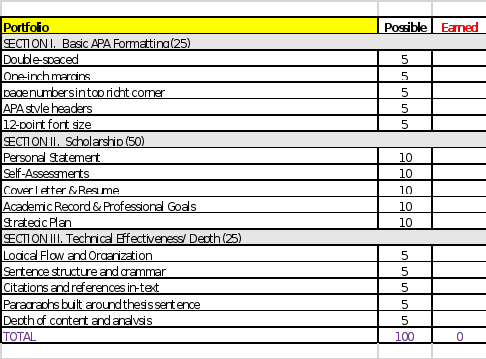
Portfolio Purpose: Record of each student’s academic goals, objectives, accomplishments, and future plans

Final Project – Start of Portfolio

During your time as an undergraduate student, you will have a range of experiences and will build several competencies and skills. Your portfolio will be one very explicit way of demonstrating to yourself, prospective graduate schools, and to prospective employers that you possess the skills and abilities in a variety of competency areas.

Portfolio Purpose: Record of each student’s academic goals, objectives, accomplishments, and future plans

Sections to complete for this assignment: Foreword, Personal Statement, Self-Assessments, Cover Letter, Professional Resume/CV, Academic Record, Academic and Professional Goals, Strategic Plan for meeting your goals.

Project Format

Abstract

Foreword

  • Personal statement addressing your reasons for choosing the field of psychology. Your professional philosophy and goals should be described.

Goal Statements and Career Planning

  • Self-Assessments
    • Explanation of Strengths
    • Developmental Areas
    • Opportunities and Challenges
    • Results of Personality Inventories
  • Cover Letter
  • Professional Resume/CV
    • Include experiential learning experiences as well as professional memberships
  • Academic Record – Neatly Displayed
    • Required Courses
    • Courses Completed
    • Course Plan
  • Academic and Professional Goals
  • Strategic Plan for meeting these goals

Awards & Honors (if you have anything to place in this section)

  • University and/or Community Service
  • Outstanding scholarship
  • Honors Convocation Recognition
  • Extra-curricular activities
  • Athletic Accomplishments
  • Social Contributions

Summary

References

Notes about submission:

Your paper must show a significant level of self-reflection and assessment.

The most critical components of your portfolio are your reflective narrative and detailed plan for success. I must know what you have learned about the field, about yourself and developed a detailed plan. Also, it should be clear how this portfolio relates to information we have covered in class or that you have read in your textbook.

This is a critical component of your grade.

  • You should also include a foreword, which provides a narrative overview at the beginning of your portfolio and a summary page at the end.
  • A table of contents should also be included and a reference page.
  • The entire submission must be professional, including the assessments.
  • You conducted the self-assessments in Lab 2, but you are welcome to do others.
  • Please use the APA format and style.

Start of Portfolio Rubric

You are presenting your portfolio via a YouTube video.  The focus of your 4-5 minute presentation should be on your development plan. You should discuss your goals, but the detailed development plan i 1

Artificial Sanity

Artificial SanityPlease go to the following case:

http://sciencecases.lib.buffalo.edu/cs/files/artificial_sanity.pdf

1. Discuss some accepted models of mental illness, i.e., psychological, biological, behavioral. How do these differ? What assumptions are being made?

2. How do these different models influence the treatment of people with mental disorders?

3. Tell the class the history of the present case. What does “right to treatment” entail for Singleton? Does Singleton have schizophrenia in your opinion?

4. What are the assumptions about mental illness held by Singleton’s lawyer and the prosecutor? Support your answer with direct quotes from each lawyer.

5. Each lawyer appears to believe in a different model of mental illness. What model is each lawyer using to support his/her argument about how Singleton should be treated?

6. What is artificial sanity? Argue your own side of the case.

Hide 

Hogg’s (2014) paper on uncertainty and extremism.

Discussion boards provide students an opportunity to share their unique perspective, make recommendations, provide an opinion, or answer a question about an issue. Each response should be professional and must be written well (follow rules of grammar and mechanics), clearly, and concisely. In general, students should support each of their claims using empirical evidence, logic and reason, or both. After posting a response, respond to another student’s post. When responding to others it is best to add support to their claims or add evidence or logic that goes against their claims. Please remain professional, constructive, and open-minded when responding to those whose perspectives differ.

Read Hogg’s (2014) paper on uncertainty and extremism. Then answer the following questions in the discussion board. Use evidence and rationale from the article in your answers. Remember to comment on others students answers.

Your answer and response are due prior to the end of week 5. Your work will be assessed using the following rubric. Please note, that extreme groups are any social group whose ideas, ideology, or beliefs are non-normative or extreme in terms of strength of belief.

1. What sorts of situations, or what times of life, lead people to feel uncertain, anxious, or insecure?

2. Are the teen and emerging adult years — a time of changing ideas, shifting identities, and vocational questions — years of increased uncertainty, and therefore of potential interest in extreme groups? Do you think older adults in transition (e.g., retirees) might be targets of extreme groups? Why or why not?

3. What sorts of extreme groups (or cults) might appeal to people in times of personal uncertainty?

Category

Unacceptable (0-16)

Problematic (17-18)

Satisfactory (19-22)

Good (23-25)

Theories & Concepts

o    Inappropriate

o    Incorrect

o    Incomplete

o    Relevancy vague

o    Major inaccuracies

o    Lacking completeness

o    Relevancy implied

o    Minor inaccuracies

o    Too broad

o    Relevancy described

o    No inaccuracies

o    Thorough

Application

o    Inappropriate

o    Incorrect

o    Incomplete

o    Relevancy vague

o    Major inaccuracies

o    Lacking completeness

o    Relevancy implied

o    Minor inaccuracies

o    Too broad

o    Relevancy described

o    No inaccuracies

o    Thorough

Research Evidence

o    Inappropriate

o    Incorrect

o    Incomplete

o    Relevancy vague

o    Major inaccuracies

o    Lacking completeness

o    Relevancy implied

o    Minor inaccuracies

o    Too broad

o    Relevancy described

o    No inaccuracies

o    Thorough

Interpretation & Integration

o    Improper format for question

o    Several grammatical/spelling errors

o    Unclear or haphazard organization

o    Proper format for question

o    Few grammatical/spelling errors

o    Focused and integrated organizatio

cognitive and physical factors related to distracted driving

Overview: For this assignment, due in Module Four, you will write a short paper discussing the cognitive and physical factors related to distracted driving. You have probably seen news stories about the dangers of talking on a cell phone or texting and driving. Logic tells you it is a disaster waiting to happen, but you may not have known the science behind the risk. Prompt: You should have a clear picture of how cognitive and physical limitations combine to form a dangerous situation. Write a short paper addressing the following:  How do both cognitive and physical factors contribute to accidents when drivers talk on their cell phones and/or text behind the wheel?  Using the Shapiro Library Database Index: A-Z Databases or a credible website such as the Association for Psychological Science (APS), find a research study that investigates the risk of distracted driving and incorporate it into your paper. For example, the following study from the APS site discusses the fact that most drivers believe their skills are above average. This study, When It Comes to Driving, Most People Think Their Skills Are Above Average, could be used to propose that drivers’ overconfidence might lead them to take more risks or lead to greater inattentiveness. You cannot use this study for your own paper, but the example should spark some ideas for choosing and incorporating studies into your own research.  Citations: Use material from Chapter 4 in your textbook to back up your explanations of the cognitive and physical factors you have investigated, and properly cite that information in APA format. Also be sure to list your research-study references, including the textbook, in APA format. Refer the Purdue OWL Reference Page Formatting to facilitate this. As a reminder, please refer to the tutorials at the Smarthinking Online Tutoring Service to assist you in your writing. Guidelines for Submission: Your short paper must be 1–2 pages in length. It should be in 12-point Times New Roman font, with one-inch margins and all references cited in APA format

e controversy of whether hypnosis is an altered state of consciousness (comparing the theories presented by Hilgard and Barber).

write a 1 page, double spaced paper on the controversy of whether hypnosis is an altered state of consciousness (comparing the theories presented by Hilgard and Barber).

Ernest Hilgard and Theodore X. Barber, It has to be a comparison of both their theories.

iscuss and contrast three different sleep disorders that either you or others in your life have experienced.

discuss and contrast three different sleep disorders that either you or others in your life have experienced.

This should be pretty easy. It just needs to be short, about half a page.

five key questions about how to use the Bible in counseling.

Article attached.

· Discuss five key questions about how to use the Bible in counseling.

· Discuss nine areas in which the Bible influences your practice of Christian counseling.

· Identify key strategies and potential problem areas in using the Bible in Christian counseling.

A. Integrate faith and spirituality in the counseling process where appropriate in an ethically competent manner.

B. Develop a personal theory of integrative counseling that includes a rationale for the interdisciplinary application of counseling theories, faith, and spiritual principles.

C. Assess client needs in an integrative pattern that is adapted to the client’s Christian religious or spiritual practices.

D. Apply intrapersonal integration and personal spiritual formation to counseling.

F. Discuss various aspects of worldview and how these relate to counseling.

Summarize the Journal Article Content – 2 pages

· Summary is concisely worded (but of sufficient length in order to adequately provide a complete review of the article).

· Summary includes all major topics of the article (if the article is a research study, briefly describes hypotheses, methods, results, discussion, and implications).

· Summary is the foundation for the subsequent 2 sections of paper.

Interaction with Journal Article 1 page

· Interaction includes a clearly stated Initial response to the article,

· Comments about design/methodology (if appropriate),

· Insights gained,

· Reasons for your interest in topic, and

· Future research interest based on topic.

· It also includes information from other sources outside the article (previous textbooks, articles, Scripture, ethical codes, etc.) that directly relate.

Application of Journal Article 1 page

· Application is approximately 1 page of text.

Application of the article’s core ideas from the article are related to a specific counseling situation (describe the scenario and counseling issue).

  1. In your final section (in approximately 1 page) write how you would apply the information you have learned from this article to a particular counseling situation. This could be in a church or clinical session. Develop this section as if you are a pastor or clinician and your parishioner or client has come to you with a problem—grief, depression, substance abuse, infidelity, etc.—and is needing your help. Adequately describe the counseling scenario, including the presenting problem. Draw out concepts from the article and apply the concepts to the scenario as if you were guided only by the content of the article. Show the reader how you are expressly drawing from the journal article in this application section; be sure to cite correctly in current APA format.

Mechanics

No grammar, spelling, or punctuation errors are present. Voice and person are used correctly and consistently (no second person pronouns).Writing is precise. Word choice is appropriate.

APA Format Elements

Citations and format are in current APA style. Cover page, Citations, Running head, and References are correctly formatted. Paper is double-spaced with 1-inch margins and written in 12 point Times New Roman font. An Abstract is not needed

Hide 

“Principle of Accuracy and the Principle of Charity” f

One of the most important ways to grow intellectually (and otherwise) is to actually listen to others and seek to understand them as they intend to be understood. Yet it is all too common for people to understand others in ways that do not reflect the best and most fair interpretation of their intended meaning.

Prepare: Review “Principle of Accuracy and the Principle of Charity” from Chapter 9, along with the required resources from this week.

Reflect: Find specific examples in the media or in life in which someone misunderstands someone else. This happens a lot with political and religious arguments, but it also happens in daily life, especially when we find ourselves in conflict with others. Have you interpreted others uncharitably?

Write: Present a case, either in the media or in your own life, in which someone interpreted another uncharitably. What specifically did the first person say? In what way did the other person understand it? What did the person really mean? Do you think that the misunderstanding was intentional? What were the consequences of the misunderstanding? How might the situation have been better if the person had practiced the principle of charity? Finally, are there areas in which you could do more to understand others favorably? How might you be a wiser person if you did so?

Guided Response: Post a minimum of three responses, two of which must be to your classmates. The third response could be to a classmate or your instructor. Be sure to post on three separate days throughout the week to promote further engagement and discussion. Each response should be a minimum 75 of words.

Share an example in your own life in which you have experienced a similarly uncharitable interpretation of someone (and what the consequences were). You might offer another possible charitable interpretation of what the first person said. You might offer suggestions for things that people can do to further better mutual understanding. Let your response further the goal of the appreciation of the shared goal of furthering charitable interpretation.

Hide 

Ordinal or interval scale of measurement and norm-referenced test.

While opinions and reactions are personal and subjective in nature, they need references and citations for support. This approach reflects knowledge acquisition as well as application and synthesis of content. In other words, always support your work with resources. This is also applies to article reviews and/or reflection exercises…you still must have at least two references….one of which will always be your textbook.

(Cohen, R. J., & Swerdlik, M. E. (2018).Psychological testing and assessment: An introduction

to tests and measurement (9thed). New York, NY: McGraw-Hill.)

(Peer Post)

Discuss the impact of each scale of measurement on the ability or inability to be utilized on a test being standardized as a norm-referenced or criterion-referenced assessment. For the purpose of this discussion, you may cluster the ordinal and interval scale together. Subsequently, your post will include the following four elements:

  • Ordinal or interval scale of measurement and norm-referenced test.
  • Ordinal or interval scale of measurement and criterion-referenced test.
  • Ratio scale of measurement and norm-referenced test.
  • Ratio scale of measurement and criterion-referenced test.

Provide at least one example that is not in yourPsychological Testing and Assessmenttext for each combination above and describe how the referencing data would be collected.