For the Part 1 application (approximately 3–4 pages of content with a
title page and references in APA format) address the following:
Describe your selected population health issue and the population affected by this issue.
Summarize the two advocacy campaigns you researched in this area.
Explain the attributes that made those campaigns effective.
Begin to develop a plan for a health advocacy campaign that seeks
to create a new policy or change an existing policy with regard to the
issue and population you selected. Be sure to include in your plan:
A description of the public health issue and proposed policy solution
Specific objectives for the policy you want to be implemented
Begin to substantiate of your proposed campaign by data and evidence.
Be sure to paste the rubric at the end of your paper.
https://academicpapers.net/wp-content/uploads/2020/08/LOGO-300x75.png00Lizhttps://academicpapers.net/wp-content/uploads/2020/08/LOGO-300x75.pngLiz2022-06-22 06:52:102022-06-22 06:52:10Developing a Health Advocacy Campaign
1. Select 3 readings from this week’s reading list (week 7)
2. Write a “3-2-1” Reflective Journal for each selected reading. Your Reflective
Journal should contain all the following elements:
a. Specify which readings you selected for this assignment.
b. Elaborate on 3 major points raised by each of the readings. Do you agree
or disagree with the authors? Please explain your rationale.
c. Write 2 questions you would ask the authors of the readings you selected
(a total of 6 questions).
d. Write about 1 personal connection to each reading (be sure to include a
quote from the reading from which you are drawing this connection, and
cite the reading correctly)
https://academicpapers.net/wp-content/uploads/2020/08/LOGO-300x75.png00Lizhttps://academicpapers.net/wp-content/uploads/2020/08/LOGO-300x75.pngLiz2022-06-22 06:20:492022-06-22 06:20:49read the readings and write a journal fllow the requirments
https://academicpapers.net/wp-content/uploads/2020/08/LOGO-300x75.png00Lizhttps://academicpapers.net/wp-content/uploads/2020/08/LOGO-300x75.pngLiz2022-06-22 06:04:032022-06-22 06:04:03short question on the book “interplay-the process of interpersonal communication”
1- Imagine you are giving a speech where you wish to Persuade your audience to adopt a dog or cat rather than buy. Which of Maslow’s needs do you think you could tap into to make your case stronger?
——————–
2-
Think back to the first day when I asked you what you wanted to achieve in this course. Do you believe that you achieved that goal? What is a concept from the class that you think you will take with you from this course (it can be from the readings or lectures, or something you experienced in the preparation or presentation of speaking publicly)
————————————-
3-
1-What rhetorical or language tool do you think is the most important? explain your answer
2) Why is language so important for persuasive speaking. Explain your answer
——————————
4-
Watch the following episodes of Point Taken: What did you notice in the examples of the show Point Taken as it applies to us in this course? How does the show approach argumentative speaking? What tools from our persuasive speech lesson are they using?
https://academicpapers.net/wp-content/uploads/2020/08/LOGO-300x75.png00Lizhttps://academicpapers.net/wp-content/uploads/2020/08/LOGO-300x75.pngLiz2022-06-22 05:50:032022-06-22 05:50:03I need to four discussion
okyo (CNN)Yet another natural disaster has struck part of Japan, continuing a summer of chaos that has seen the country weather deadly floods, typhoons, earthquakes, landslides and heatwaves.
At least 9 people were killed in Thursday’s earthquake, Chief Cabinet Secretary Yoshihide Suga said Friday.
The government had previously said 16 people died, but Suga told reporters later that this figure was incorrect and officials had mistakenly also counted those who suffered heart attacks due to the quake.
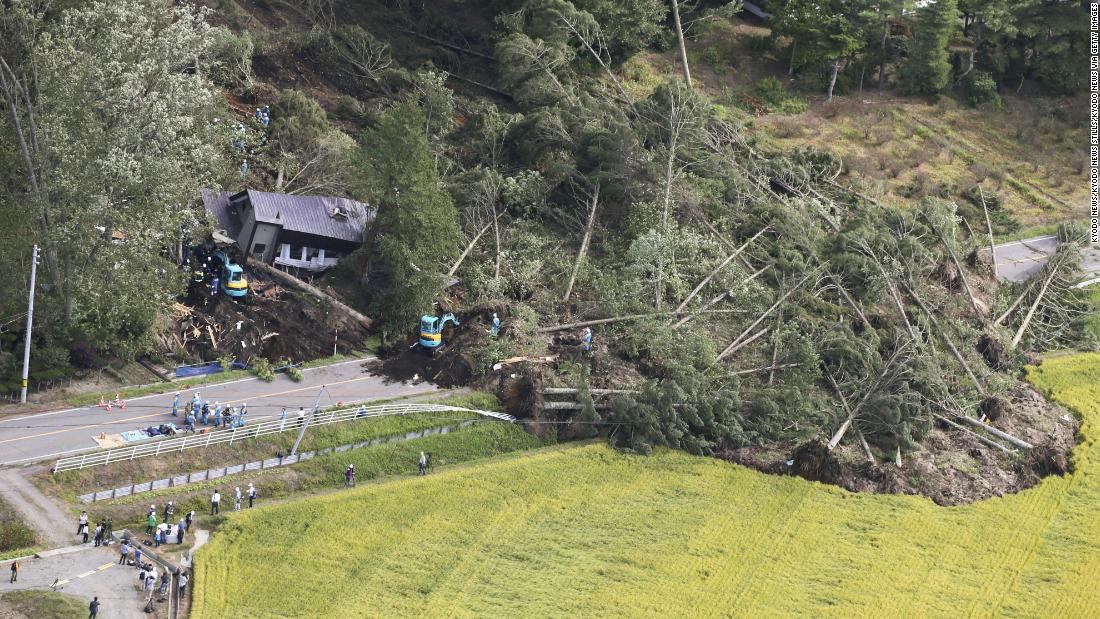
Photo taken Sept. 6, 2018, from a Kyodo News airplane shows the site of a landslide in Atsuma, Hokkaido, northern Japan, triggered by an earthquake with preliminary magnitude of 6.7 that struck the region.
Search and rescue teams are still looking for 26 people missing in the western town of Atsuma in Hokkaido Prefecture. Prime Minister Shinzo Abe said that more than 22,000 people were involved in the rescue efforts, as the northern island still deals with the after effects of the magnitude-6.6 quake, which caused landslides that buried homes and other buildings.
Electricity was restored to around 1.4 million buildings as of Friday morning, Abe added, around half of all of those which initially lost power.
More than 150 people were injured by the quake, mostly in Sapporo, said Kazuya Isaki, an official with the Crisis Management Office of Hokkaido Prefecture Government. Dozens of people were reported missing in Atsuma, near the epicenter of the quake, where four of the deaths occurred.
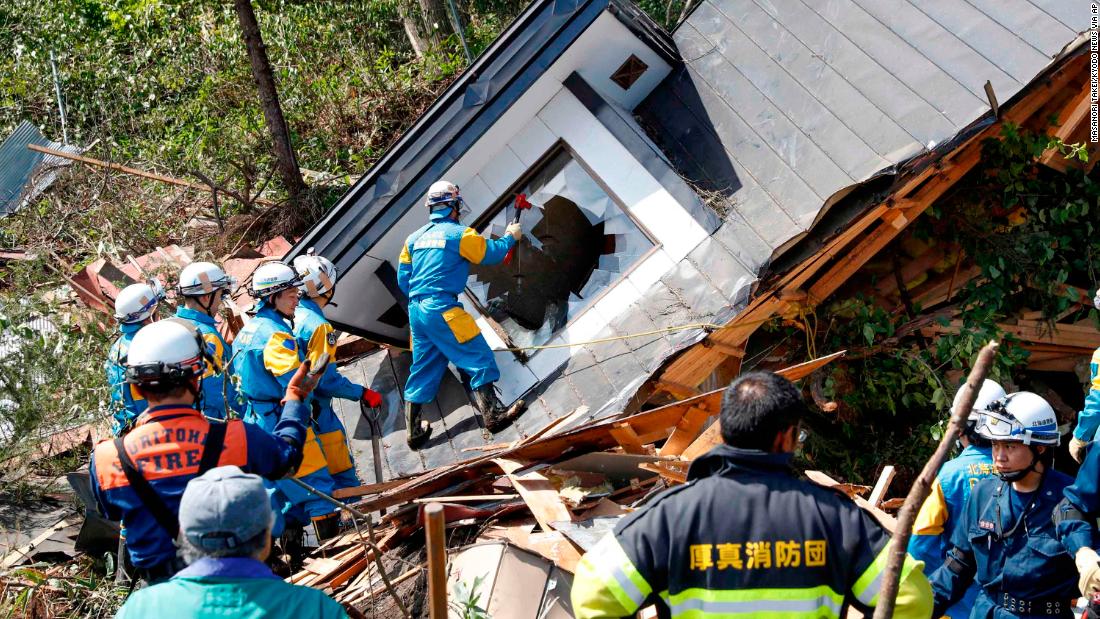
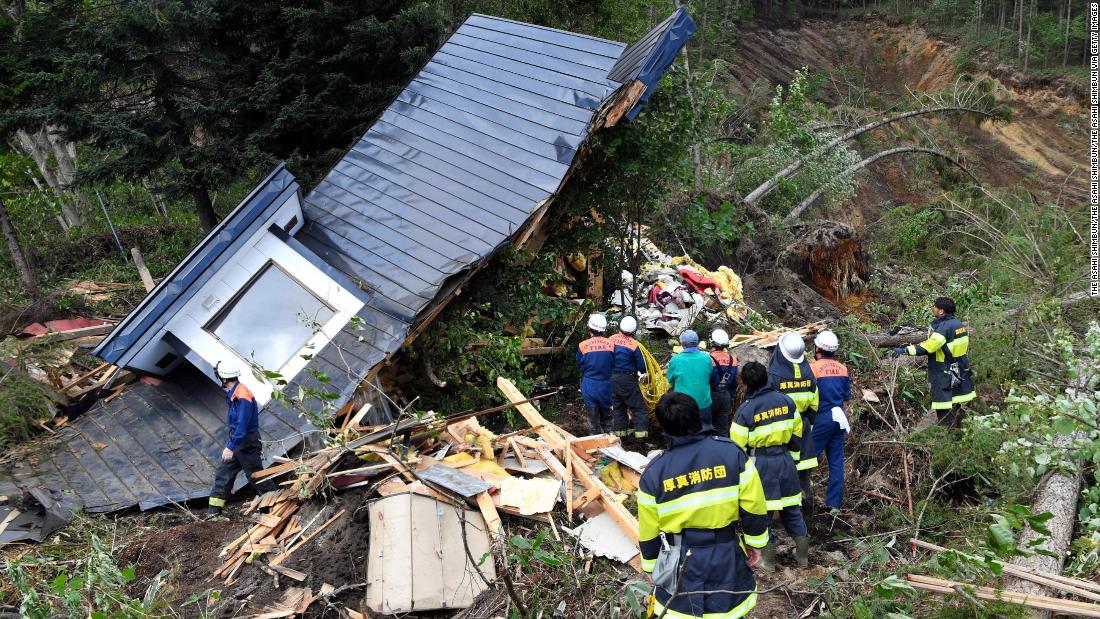
Police search for missing persons around a house destroyed by a landslide after a powerful earthquake in Atsuma town, Hokkaido, northern Japan.
Public broadcaster NHK reported that flights and public transport across the region had been brought to a standstill.
Nearly 3 million households lost power, according to the Hokkaido Electric Power Company. Officials said a main power station lost operations, affecting other sites. Independently owned power generators were assisting.
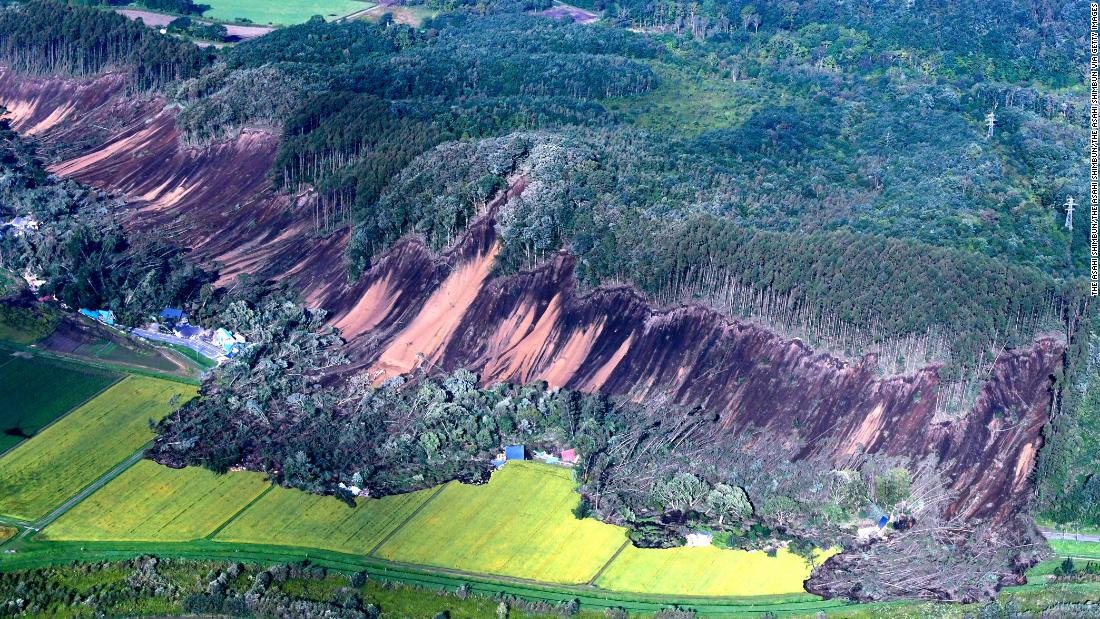
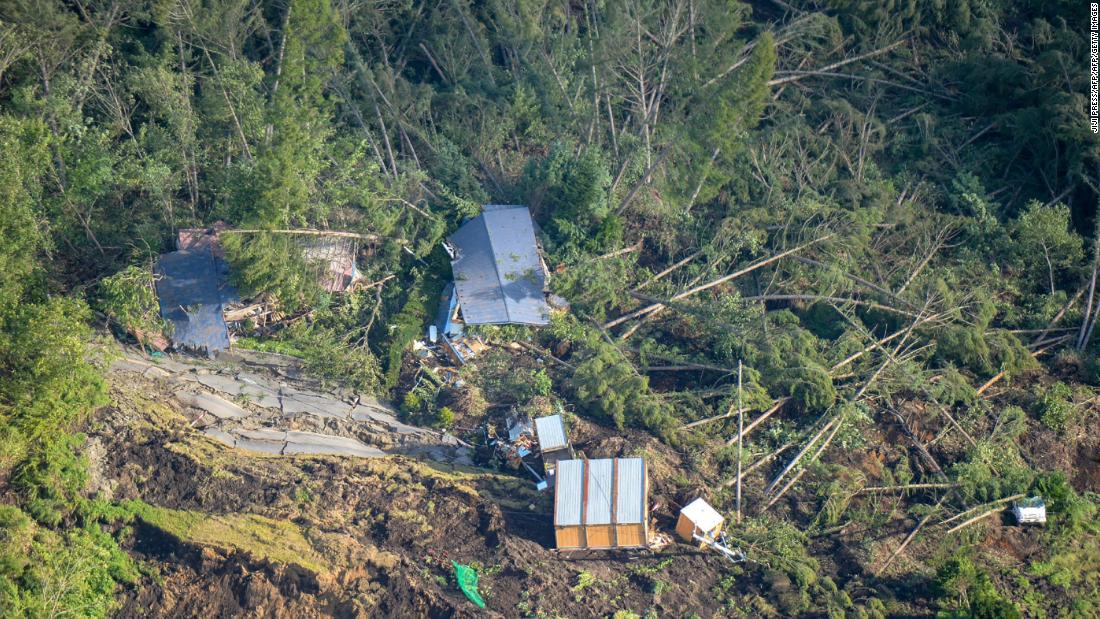
In this aerial image, houses are buried by multiple landslides after a powerful earthquake jolt on September 6, 2018 in Atsuma, Hokkaido, Japan.
“The electric supply was stopped to Tomari nuclear plant, but it can operate without external electric supply for one week,” Chief Cabinet Secretary Yoshihide Suga said.
The powerful quake lasted almost a minute, jolting residents from their beds and collapsing roads.
Near the epicenter, landslides wiped out houses in the tiny town of Atsuma, home to 40 residents. Officials said multiple people were still missing hours after the initial quake.
A rescue operation is conducted at a house destroyed by a landslide after a powerful earthquake on September 6, 2018 in Atsuma, Hokkaido, Japan.
Photos from Sapporo, Hokkaido’s main city on the western part of the island, showed huge cracks in the street and subsided houses.
More than 4,000 defense force soldiers have been deployed to help with rescue operations, Prime Minister Shinzo Abe said, and that number could rise to 25,000 if needed.
This picture shows an aerial view of houses damaged by a landslide in Atsuma town, Hokkaido prefecture on September 6, 2018, after an earthquake hit the northern Japanese island of Hokkaido.
Helicopter rescue crews were also dispatched and have airlifted around a dozen people to safety. Evacuation shelters have been set up in many towns and cities around the region.
Aftershocks were continuing Thursday morning, and could pose a risk for the next week, according to the Japan Meteorological Agency, which warned residents of the increased risk that buildings could collapse near the epicenter of the original quake.
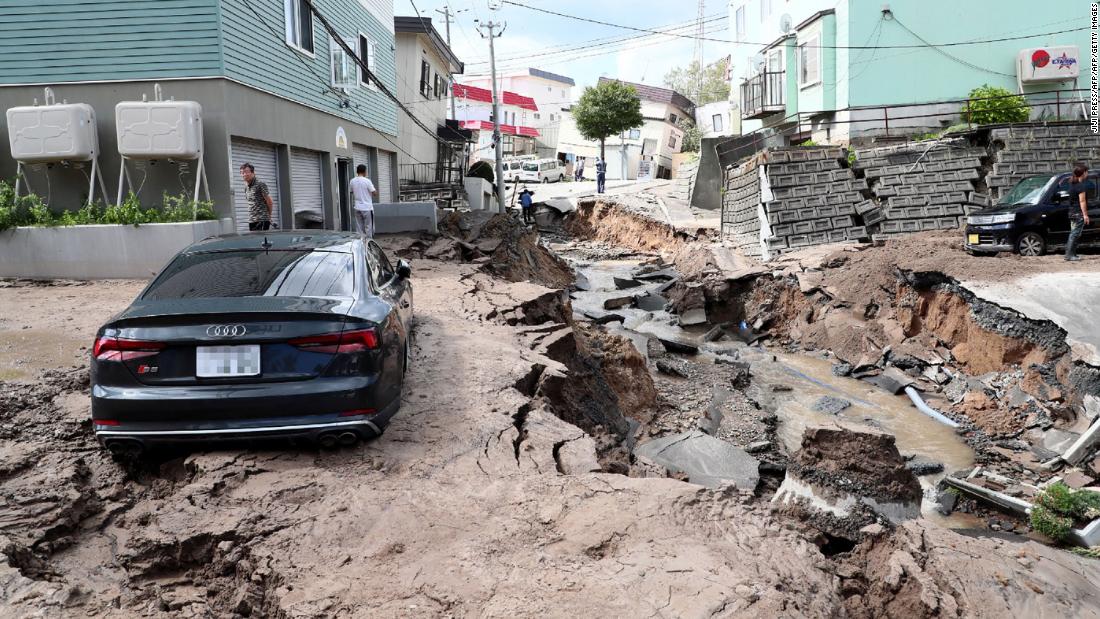
A car is seen stuck on a road damaged by an earthquake in Sapporo, Hokkaido prefecture on September 6, 2018.
High winds smashed a tanker into a bridge, forced one of the country’s largest airports to close and left at least 10 people dead.
On Japan’s main island of Honshu, nine cities and towns issued compulsory evacuation orders. A further 53 issued non-compulsory evacuation orders.
Before it made landfall, the storm had sustained winds of 140 kilometers per hour (87 mph) and gusts of 165 kmh (102 mph), the equivalent of a Category 1 Atlantic hurricane.
https://academicpapers.net/wp-content/uploads/2020/08/LOGO-300x75.png00Lizhttps://academicpapers.net/wp-content/uploads/2020/08/LOGO-300x75.pngLiz2022-06-22 05:41:562022-06-22 05:41:56Earthquake buries homes under
These assignments are limited to one page (typed) (in 10 or 12 point type) responses to the questions assigned. One page means one page, no more. The format is: Statement of the Facts, Issues or Tax Question, Answer, Rationale, Resources Used (non-text). Assignments are due on the date shown on the Assignment Sheet. Lexis-Nexis, Checkpoint/RIA and CCH Intelliconnect will be significant research tools in completing these assignments. Please use proper citation form (as described in Chapters 1 & 2 of the Text). Each submission must contain at a minimum one reference to the Internal Revenue Code (26 USC §___) or applicable Regulation and one federal case law citation (Tax Court, US District Court, US Appeals Court, US Supreme Court). Please note that case citations should include a discussion of how case findings can be applied to the facts in the problem. Each student may submit three research problems during the term. Please submit your best work – there are no “do-overs”. Failure to properly format your research will result in a grade of zero. A sample student research problem answer is available on the Documents tab on Blackboard. The grading rubric is also available on Bb. A document template is posted on Bb and must be sued for each submission. Spelling and proofreading matters so proof your assignments carefully. It is common for a student to receive a zero score for a poorly proofed paper. Students may submit only three research problems of those assigned for grading and two must be submitted by October 16//17 to be marked. Students submitting more than three RP assignments will be docked 40 penalty points and the additional submission(s) will not be graded. Note, since students are accorded choices in turning in papers, the smart call is to turn in the assignments early. No late papers are accepted for any reason so it is smart to turn assignments in early to avoid any potential problem that might arise at the last minute.
Write a 1,200-1,500-word essay that describes the characteristics and roles you hope to embody as a counselor and the counselor dispositions that you want to bring with you. You may write in the first person for this assignment. Include the following in your paper:
Your role as the therapist in the counseling process within community and private mental health systems
Refer to the Counselor Dispositions. Which of these dispositions will you incorporate into the counseling relationship and how?
Counseling skills you plan to practice for building rapport with clients
Prepare this assignment according to the guidelines found in the APA Style Guide, located in the Student Success Center. An abstract is not required.
This assignment uses a rubric. Please review the rubric prior to beginning the assignment to become familiar with the expectations for successful completion.
You are required to submit this assignment to Turnitin. Please refer to the directions in the Student Success Center.
This assignment meets the following CACREP Standards:
2.F.5.f. Counselor characteristics and behaviors that influence the counseling process.
2.F.5.g. Essential interviewing, counseling, and case conceptualization skills.
5.C.3.d. Strategies for interfacing with integrated behavioral health care professionals.
5.C.3.e. Strategies to advocate for persons with mental health issues,
https://academicpapers.net/wp-content/uploads/2020/08/LOGO-300x75.png00Lizhttps://academicpapers.net/wp-content/uploads/2020/08/LOGO-300x75.pngLiz2022-06-22 04:57:512022-06-22 04:57:51Counseling skills you plan to practice for building rapport with clients, psychology homework help
The Briargrove Project has successfully completed multiple phases within the corporate offices. The project is prepared to move into remote offices across the organization. In your paper address the 4 key stages of project monitoring and how that will be useful for the ongoing project.
Conclude the assignment with these 2 components.
Reflections on the Progressive Case Study.
What are the top three factors that you improved during this course?
The following requirements must be met:
Write between 1,500 – 2,000 words using Microsoft Word in APA 6th edition style.
Use an appropriate number of references to support your position, and defend your arguments. The following are examples of primary and secondary sources that may be used, and non-credible and opinion based sources that may not be used.
Non-credible and opinion based sources such as, Wikis, Yahoo Answers, eHow, blogs, etc. should not be used.
Cite all reference material (data, dates, graphs, quotes, paraphrased statements, information, etc.) in the paper and list each source on a reference page using APA style. An overview of APA 6th edition in-text citations, formatting, reference list, and style is provided here.
Respond to both below questions with a minimum 250 word response. (Chapter eight page is attached.)
Chapter 8 of the textbook addresses the prevalence of Domestic Violence. Identify and discuss the factors faced by police during domestic violence calls and the issue of mandatory arrest. Do you agree or disagree with mandatory arrest policies for domestic violence calls? Why or why not?
The National Security Administration’s Terrorist Surveillance Program (TSP) was developed as an intelligence gathering tool to assist in the investigation and prosecution of terrorist-related activity. The TSP and the Bush Administration came under a great deal of criticism from members of Congress as well as civil rights organizations such as the ACLU and Amnesty International. Critics of the TSP referred to the program as “domestic spying,” and President Bush was frequently accused of acting “above the law” in instituting the TSP without Congressional approval. Based on your readings in the textbook, the additional reading material provided, and your own, personal research, do you believe the President acted “above the law” or within his powers as delegated by the U.S. Constitution when he approved the TSP without seeking Congressional approval? Why or why not?
https://academicpapers.net/wp-content/uploads/2020/08/LOGO-300x75.png00Lizhttps://academicpapers.net/wp-content/uploads/2020/08/LOGO-300x75.pngLiz2022-06-22 04:44:042022-06-22 04:44:04Answer the following discussion questions