- Review again the Canvas Module B, including the Writing and Q&A Guidelines PDF
-
- Read and review the Chapters 08, 09, 11, 12, 14 and 15 in course textbook A World of Art by Sayre
-
- After reading and review is complete, write a complete response for ALL of the questions below (near the bottom, after all instructions and guidance points are provided).
The length of each response will vary, depending on the nature of the question. Written responses will be assessed based on the Grading Key for Written Responses Q&A and students must adhere to the Writing and Q&A Guidelines and Requirements PDF. All of the responses must be evidence-based upon the content in pages presented in this module AND previous module pages; students will NOT write opinions or interpretations of their own.
EXAMPLE of a written response that meets all expectations (including citations from vocab guides, study guides, and textbook):
Question:
Citing from the Vocabulary Guide 1, please define Neoclassicism. Then based upon and citing from studies in the History of Western Architecture and Art, in Chapters 28 and 29, please discuss the style of Neoclassicism: what reasons specifically motivated artists and architects in late 18th Century France and United States to adopt Neoclassicism? Please respond by including a discussion of French artist Jacques-Louis David’s 1784 Oath of the Horatii painting AND American architect Robert Mills’ 1835 design for the United States Treasury Building in Washington, D.C. Please write a complete response to BOTH questions. This written response is best organized into three (3) or four (4) comprehensive paragraphs and will require approximately 550 to 600 words in order to be complete and correct. Please remember to use citations.
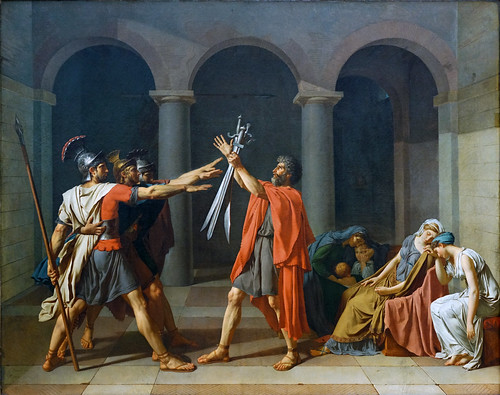
Jacques Louis David, Oath of the Horatii 1784 France

Robert Mills, U.S.Treasury Building 1836-1842, United States
Written Response:
According to the Vocabulary Guide 1, the term Neoclassicism refers to a style of art and architecture in 18th and 19th Centuries in Europe and the United States, marking a general revival of interest in the aesthetics and ideas of Classical Antiquity, that is, of ancient Greece and ancient Rome (ART 2C Vocabulary Guide 1, pg. 02).
Artists in late 18th Century France were motivated to adopt Neoclassicism for reasons that were essentially political. During the late 18th Century occurred the French Revolution, in which a large-scale uprising of laboring classes both rural and urban, led by educated middle-class thinkers of the Enlightenment, successfully overthrew the French monarchy. For many French artists working during this period, the ancient Greek and Roman styles offered a visual aesthetic of simplicity, heroism and self-sacrifice that corresponded with the spirit of the French Revolution (Sterlinger, pg 217). In Neoclassical visual art, the postures and gestures of figures were modeled after ancient Roman statuary, such as the Augustus of Primaporta or the reliefs on the Column of Trajan (pg. 211).
An example of this, the 1784 painting by Jacques-Louis David, Oath of the Horatii, visually communicated support for the Revolution by connecting French citizens with the heroic warriors of ancient Rome. The painting represents a narrative from an ancient Roman legend involving two warring cities, and the three brothers who were willing to sacrifice their lives for the good of Rome (Sterlinger, pg. 217). David strongly believed that paintings of noble events in ancient history would encourage moral obligation, patriotism and civic virtue in revolutionary France (pg. 218). Also, the visual simplicity of the Oath of the Horatii is notable when compared to paintings of the previous Rococo and non-religious Baroque styles of the upper-class and aristocracy, respectively. In fact, the visual simplicity of the Oath of the Horatii painting had an austerity that has long been interpreted as a conscious reaction to the Rococo and Baroque styles’ extravagance and luxury, as well as a condemnation of the upper-class and aristocracy who maintained centuries of authoritarian rule in France (pg. 218)
Like the Revolution in France, the concurrent late 18th Century American Revolution was led by educated middle-class thinkers of the Enlightenment, whose colonial and allied troops successfully overthrew the English monarchy. Also, like the art and architecture of the French Revolution, architect Robert Mills’ 1835 design for the new U.S. Treasury Building in Washington D.C. could not be fashioned in the previous Rococo or non-religious Baroque styles because those luxurious and extravagant styles did not reflect the values or revolutionary spirit in the new American Republic, the United States (Sterlinger, pg. 229). It is important to remember that the Neoclassical visual aesthetic was rooted in the ancient Classical period Greek style, which was a style founded in the values of rationalism, idealism, democracy and humanism. The Enlightenment thinkers of 18th Century Europe and America inspired revolutions in support of rational thinking and democracy, including separation of Church and State, the right to vote in an electoral process, the right to assemble, the right to an attorney and fair trial, and the right to publish without censorship. The Neoclassical style of clarity, order, balance and restraint was much more fitting as a visual expression of rationalism and democratic ideals — as well as morality — in the United States. In Robert Mills’ 1835 design for the Treasury Building in Washington D.C., the Neoclassical style was adopted to represent temperance, morality, patriotism, idealism, and civic virtue (pg. 229). Ultimately, Neoclassicism offered a conservative visual style worthy of stately buildings for the government of the United States, but with stricter moral standards for its revolutionary population (pg. 230).
*
Another EXAMPLE of a response that meets all expectations (including citations from study guides, textbook):
Question:
The Woman or “Venus” of Willendorf (ca. 28,000 – 24,000 B.C.E.) from Austria, and the Human Figure (ca. 6500 B.C.E.) from ‘Ain Ghazal, Jordan, are BOTH sculptural representations of the human form. However, these two sculptural representations were informed by significantly different historical circumstances. With this in mind, please write a comparative analysis, discussing specific ways in which the relatively much newer Human Figure of ‘Ain Ghazal differs from the much older “Venus” of Willendorf AND please explain how these differences seen in the Human Figure of ‘Ain Ghazal are representative of major historical changes for human beings. This written response is best organized into three (3) or four (4) comprehensive paragraphs, and will require approximately 700 words in order to be complete and correct. Please remember to use citations.
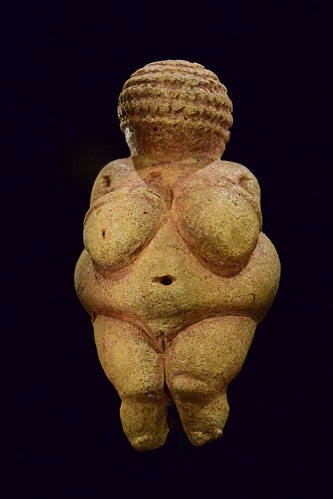
Woman or “Venus” of Willendorf, Austria, ca. 28,000 – 24,000 B.C.E. Paleolithic
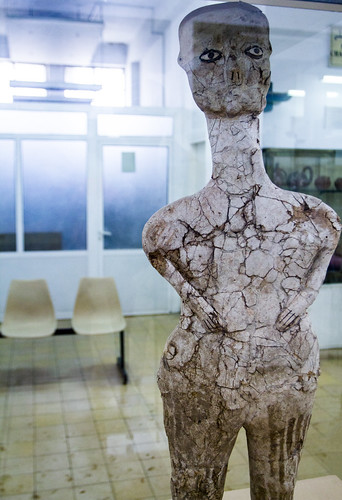
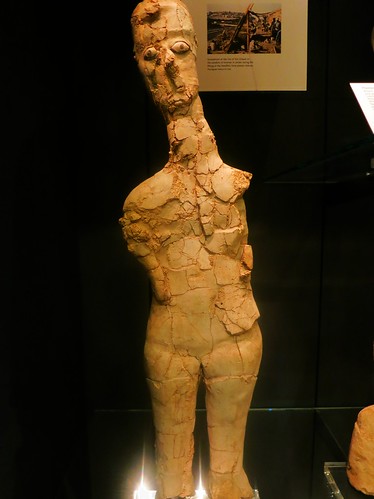
Human Figures from ‘Ain Ghazal, Jordan, ca. 6500 B.C.E. Neolithic
Written Response:
The “Venus” of Willendorf (ca. 28,000 – 24,000 B.C.E.), from Austria, and the Human Figure (ca. 6500 B.C.E.), from ‘Ain Ghazal, Jordan, are both sculptural representations of a human form; beyond this similarity, the two art works are different in almost every way.
The “Venus” of Willendorf was created during the Paleolithic period (ca. 30,000 to 9,000 B.C.E.). This period corresponds to the last Great Ice Age, when frozen glaciers covered much of the European continent. The Paleolithic peoples were nomadic, that is, they moved from place to place following the herds of animals as the glaciers froze and thawed (Study Guide Chapter 01 pg. 01). The nomadic culture of the Paleolithic people helps to explain the very small size of the “Venus” of Willendorf, only 4 and 3/8 inches, because only a very small art work could be carried from place to place (Study Guide Chapter 01 pg. 02). The “Venus” of Willendorf is believed to have some symbolic purpose, as the Paleolithic peoples did have the capacity for spoken language and sign-making (pg. 01). The exaggerated size of the sculpture’s breasts, womb and belly, suggest that it might have been a symbol of female fertility, especially because survival was difficult during the Paleolithic period and healthy child-bearing women were very important (pg. 01). Beyond meanings of fertility, other analysis suggests that Paleolithic female sculptures, such as the “Venus” of Willendorf, were used as communication devices to create alliances between hunter-gatherer clans (Stokstad, pg. 07). This also points to the fact that survival was difficult during the Paleolithic period, and interactions and alliances among humans were highly necessary (Stokstad, pg. 07).
Meanwhile, the relatively much newer Human Figure from ‘Ain Ghazal was created during the Neolithic Period (ca. 8,000 – 3,500 B.C.E.). The Neolithic period corresponds to the agricultural developments occurring in various regions of the world, in which humans learned how to successfully domestic animals and grow their own food. The emerging human practice of harvesting crops and raising cattle is known historically as the Agricultural Revolution. The results of the Agricultural Revolution during the Neolithic Period allowed for another revolution to subsequently occur, that is, human settlement (Study Guide Chapter 02 pg. 01). Situated along the river valleys of the most fertile regions in the world, the Neolithic human settlements would eventually prosper and grow into densely populated urban civilizations (pg. 01).
One of the historically important early urban settlements in the Neolithic Near East was ‘Ain Ghazal, in present-day Jordan. The Human Figure from ‘Ain Ghazal represents these major historical changes for human beings. Instead of existing as a very small hand-held form like the “Venus” of Willendorf, the Human Figure of ‘Ain Ghazal is comparatively large, about 35 inches tall. This can be explained by the fact that Neolithic humans were settled and no longer nomadic; there was no longer a need to carry art works from place to place. Instead, the Neolithic humans, including those from ‘Ain Ghazal, created large art works like the Human Figure, which was buried together with other similar figures in underground pits. Archeological evidence suggests that the Human Figure of ‘Ain Ghazal was NOT used as a female fertility symbol or as a communication device to form alliances–as human figure sculptures were used in Paleolithic times. Instead, the Human Figure of ‘Ain Ghazal was likely used as part of rituals related to deceased persons buried beneath the houses of Ain Ghazal. This sheds light on another important change for human beings during the Neolithic period: human settlement and surplus of food allowed spare time for creative activities including the development of more elaborate funerary rituals (Study Guide Chapter 02, pg. 02). Lastly, of note is the difference in material. Instead of being carved from stone as the prehistoric “Venus” of Willendorf, the Neolithic Human Figure of ‘Ain Ghazal is created from fired lime plaster, the same material with which homes’ interiors were finished in ‘Ain Ghazal, as well as houses in earlier Neolithic settlements such as Çatalhöyük in present-day Turkey. The plaster material reinforces the connections between the Human Figure of ‘Ain Ghazal and the urban housing growth of the Neolithic Period; additionally, it serves as a reminder of how human settlement allowed for the development of more complex systems of creating objects, including kilns and other fabrication equipment.
*
Students must please submit all assignments as an uploaded file in MS Word doc / MS Word docx format.
There will be a 25% grade deduction for any written submission that is not correctly formatted. Formatting of MS Word doc submissions must adhere to the guidelines and examples shown in the previous module, incluing DOUBLE-SPACING all text, always including the original question and question number in the text.
Questions:
1.
As discussed in Sayre’s World of Art Chapter 8, please explain two (2) reasons, why drawings came to be considered finished works of art during the Italian Renaissance.
In the response, please include discussions of the art historical writings by Giorgio Vasari and the two example drawings by Leonardo: the Madonna and Child with St. Anne and Infant Saint John the Baptist (ca. 1499-1500) and Study for a Sleeve (ca. 1510-1513).
Please write, as always, in complete sentences and please write a complete response to all four (4) parts of this question.
This written response is best organized into a multiple paragraphs, and will require approximately 600 words in order to be complete and correct. Please remember to use citations, as seen in the examples above.
2.
PLEASE LEAVE BLANK and move to question 3.
3.
This question includes discussion of charcoal drawings by South African artist William Kentridge; before addressing those questions, please go to the History of South Africa organization’s website, and read the text “Background and policy of apartheid” on the homepage, followed by “What was apartheid?” also on the homepage, and then:
In the first part of the written response, please define and explain what was apartheid. Please cite only from the History of South Africa organization’s website:
http://www.sahistory.org.za/article/history-apartheid-south-africa (链接到外部网站。)链接到外部网站。
Next, citing from the Vocabulary Guide 3 PDF, please define charcoal.
Then, please then discuss the drawings of South African artist William Kentridge, who uses charcoal because it can be easily erased, smudged, and re-drawn. Later his charcoal drawings are converted into stills for short films.
Many of William Kentridge’s charcoal drawings feature a fictional character named Soho Eckstein. What is the role of this fictional character Eckstein in the work of William Kentridge? What descriptions (adjectives) could we use to describe the role of Eckstein?
Why is the artistic process of erasure, addition and re-drawing so important in creating meaning in Kentridge’s drawings?
**** Please remember to watch the History of a Main Complaint in the Art 21 exclusive video in REVEL.
Please write, as always, in complete sentences and write a complete response to all four (4) parts of this question.
This written response is best organized into a multiple paragraphs, and will require approximately 450 to 500 words in order to be complete and correct. Please remember to use citations, as seen in the examples above.
4.
PLEASE LEAVE BLANK and move to question 6.
5.
PLEASE LEAVE BLANK and move to question 6.
6.
Photography in the 19th Century was often perceived by the general public as a truthful representation: it was a transparent medium created by a camera, which was a machine that produced reality in non-manipulated form. However, like many other historians, both past and present, Dr. Martha A. Sandweiss of Princeton University History Department argues that no single photograph can fully convey the complexity of an event, experience or place (Sandweiss, pg. 02). Among the various topics addressed in her essay for the Gilder Lehrman Institute of American History, titled Photography in 19th Century America, Sandweiss includes one in consideration of truth. She argues that —despite the appearance of reality —photographs are actually social and cultural constructs (pg. 02). Acting as a recorder, the person who uses the camera and takes the photograph does so through the lens of his/her own personal ambitions and experiences(pg. 02).
Please discuss Sandweiss’s arguments in relation to the American Civil War documentary photographs by Timothy O’Sullivan —although credited to Matthew Brady —including the photograph Harvest of Death, Gettysburg, Pennsylvania, July 1863 featured in Sayre’s World of Art Chapter 8. Please address the the intentional blurring and possible staging in the photograph.
* it is NOT necessary to read the Sandweiss article; however, for any students interested in this article, it can be found on the Gilder Lehrman Institute of American History website.
Please write, as always, in complete sentences and write a complete response to this question.
This written response is best organized into a multiple paragraphs, and will require 350 to 400 words in order to be complete and correct. Please remember to use citations, as seen in the examples above.
7.
Citing from the Vocabulary Guide 3 PDF, please define silver gelatin print.
Please then consider an example from the course textbook Chapter 11, the series of silver gelatin prints by Charles Sheeler made on commission by the Ford Motor Company to document a new Ford factory at River Rogue in Deerborn, Michigan, United States. Why are these photographic works, including Sheerler’s 1927 silver gelatin print Criss-Crossed Conveyors -Ford Plant, recognized and valued as art? Please include a discussion of formal terms learned in previous chapters, e.g. composition, line, space, light and shadow, etc.
Please write, as always, in complete sentences and please write a complete response to address both parts of this question.
This written response is best organized into a multiple paragraphs, and will require approximately 250 words in order to be complete and correct. Please remember to use citations, as seen in the examples above.
8.
PLEASE LEAVE BLANK and move to question 9.
9.
CONSIDER / REFLECT:
Jeff Walls’s 1993 photographic work A Sudden Gust of Wind is modeled after a 19th Century Japanese print by Hokusai, titled Sunshu Ejiri, from the series Thirty Six Views of Mount Fuji.
How, technically, did Jeff Wall actually create his 1993 photographic work A Sudden Gust of Wind ?
How does Jeff Wall’s method of creatingA Sudden Gust of Wind engage in ideas about truth and authenticity in a photographic image?
Also, a significant consideration in the photography of Jeff Wall is his interest in transformation. Please examine carefully both Jeff Wall’s photograph A Sudden Gust of Wind (Fig. 11-48) and Hokusai’s print Sunshu Ejiri (Fig. 11-49) in the text book. What might it mean that, in Jeff Wall’s photograph, there are businessmen inhabiting the scene rather than Japanese people in traditional dress? Please provide three (3) possible meanings.
How has the landscape at Ejiri —considered in Japan as one of the most beautiful locations —been translated in Jeff Wall’s image? Please identify and explain three (3) ways in which Jeff Wall’s image A Sudden Gust of Wind is changed, compared to the original Japanese image of Ejiri, as seen in Hokusai’s print Sunshu Ejiri.
* At the end of each chapter in the World of Art textbook, there is a section titled The Critical Process and it features in REVEL as an audio/visual guide. For Chapter 11 (pages 271 and 272), The Critical Process focuses on Jeff Wall’s 1993 photographic work, A Sudden Gust of Wind.
Please write, as always, in complete sentences and please write a complete response to all four (4) parts of this question.
This written response is best organized into at least four (4) paragraphs, and will require approximately 550 to 600 words mimimum in order to be complete and correct. Please remember to use citations, as seen in the examples above.
10.
Citing from the Vocabulary Guide 3 PDF, please define all three terms: relief, sculpture in-the-round, and installation.
Then please explain what distinguishes an earth work, such as Robert Smithson’s 1970 Spiral Jetty at Great Salt Lake, from other forms of installation, such as Anish Kapoor’s 2004 Cloud Gate in Chicago? Please respond to this question using the two specific art examples of Robert Smithson’s 1970 Spiral Jetty and Anish Kapoor’s 2004 Cloud Gate.
Please write, as always, in complete sentences and write a complete response to all parts of this question. .
This written response is best organized into a multiple paragraphs, and will require approximately 550 words in order to be complete and correct. Please remember to use citations, as seen in the examples above.
11.
PLEASE LEAVE BLANK and move to question 12.
12.
A major part of the study of architecture involves understanding the man-made technologies and engineering that historically date back to the ancient periods (ca. late- 4th millennium B.C.E. to early 1st millennum C.E ).
Citing from the Vocabulary Guide 3 PDF, please explain and define the arch principle;
then please define all four (4) terms of the arch principle sequence;
then please define cast concrete vaulting also citing from the Vocabulary Guide 3 PDF
Lastly, please explain in detail how the arch principle and cast concrete vaulting were used in the 1st Century C.E. to build the famous Colosseum in Rome, Italy.
Please write, as always, in complete sentences and write a complete response to all four (4) parts of this question. .
This written response is best organized into a minimum of four (4) paragraphs, and will require 350 to 400 words in order to be complete and correct. Please remember to use citations, as seen in the examples above.
13.
U.S. architect Frank Lloyd Wright (born 1867- died 1959) envisioned of a new kind of 20th Century architecture which he believed would support American democracy and progress, and would utilize the family home as the true building block of social transformation.
Although rooted culturally, professionally and personally to the United States throughout his life, Frank Lloyd Wright maintained extended periods of residency in Japan, both for work and travel. Many of Japanese architectural works that Frank Lloyd Wright admired, such as the 17th Century Shokin Tei at the Katsura Imperial Villa, in Kyoto, and the 8th Century Sanbutsu-ji on Mt. Mitoku in Misasa (see all images images below or see PDF attached below with all images), evidence the Japanese interest in the flow of internal and external spaces between the natural and man-made environments. Also evidenced are man-made vertical and horizontal components creating harmony with the more irregular, free-flowing or jagged forms of nature. These elements of sympathetic planning (see Vocabulary Guide 3), evolved in eastern Asia over many hundreds of years. Another element of sympathetic planning is the attempt to preserve the natural lanscape by NOT plowing the land flat and NOT cutting away the rock, soil, or trees. This historically resulted in some buildings with horizontal components (including floors) elevated and projecting out from the sides of hills or mountains, as seen in the 8th Century Sanbutsu-ji on Mt. Mitoku, so as to avoid destroying the land. Note that an elevated and projecting horizontal component is a cantilever.
With this above-provided information in mind, please discuss how Frank Lloyd Wright’s use of Japanese aesthetic is evident in his house designs, specifically in his 1936 house Falling Water – the Kaufmann House in Bear Run, Pennsylvania, United States, viewable in the course textbook in Chapter 14. Please identify and explain at least two (2) similarities between Frank Llyod Wright’s Falling Water – the Kaufmann House and the Japanese historical examples: the 17th Century Shokin Tei at the Katsura Imperial Villa, in Kyoto, and the 8th Century Sanbutsu-ji on Mt. Mitoku in Misasa (see all images images below or see PDF attached below with all images).
Please write, as always, in complete sentences and write a complete response to this question.
This written response is best organized into a multiple paragraphs, and will require 350 words mimimum in order to be complete and correct. Please remember to use citations, as seen in the examples above.
Click Here —-> images for question 13 .pdf

Shokin Tei Katsura Imperial Villa, Kyoto, Japan 17th Century

Sanbutsu-ji Mt. Mitoku, Misasa, Japan ca. 8th Century

Frank Lloyd Wright Falling Water – Kaufmann House (exterior) Bear Run, Pennsylvania, U.S.A. 1936

Frank Lloyd Wright Falling Water – Kaufmann House (interior) Bear Run, Pennsylvania, U.S.A. 1936


