Alderian Theory, psychology assignment help

This
assignment needs to be original and plagiarize free…Also needs to have in-text citations…

Part 1: What were the results of
your MBTI assessment?  I am an ESFJ personality type… Do you
agree with these results?  YES, I personally do believe this is me!!
Why or why not? Explain how the MBTI assessments relate to Jung’s theory of
personality development. Discuss how this information will enable you to be
successful as a counselor. Would you use this assessment tool with your
clients? If not, why?

This section of the project
should be 2–3 pages in length.

Part 2: Develop a treatment plan
for a child that has come into your office due to acting out in the home based
on Adler’s personality theory. The child is disobeying, having temper tantrums,
and hitting their siblings. Incorporate the birth chart and the stages of
Adler’s personality development into your treatment plan, which should also
include at least two techniques or strategies.

This section of the project
should be 2–3 pages in length.

Outline
Information:

Great
resources for the development of an outline:http://academics.smcvt.edu/cbauer-ramazani/-AEP/EN104/outline_essay.htmBy Christine Bauer-Ramazani, 2006
Saint

You will be required to use
appropriate APA citations as well as the APA format. It is also required that
you use headings for these parts instead of typing the actual questions. For
example, you could use “Myers-Briggs Assessment” for part 1 and “Treatment Plan
based on Adler’s Theory” for part 2.

I am attaching
some web resources for you to use below!!! 
I also am attaching a Word doc of the chapter out of my textbook.  I have added that I am an ESFJ personality
type and that I agree it does describe me!!! 
Any questions please feel free to ask….My grading rubric is also below:
Please make sure everything on it is covered and plagiarized free!!!!!

Grading Criteria

Content

Clearly addresses Part 1 of the
assignment answering each of the following questions fully:

  • What were the results of your MBTI assessment?
  • Do you agree with these results? Why or why not?
  • In what ways does the MBTI assessment relate to
    Jung’s theory of personality development?
  • How will this information allow you to be successful
    as a counselor?
  • Would you use this assessment tool with your
    clients?

Clearly addresses Part 2 of the
assignment answering each of the following fully:

  • Develop a treatment plan for a child that has come
    into your office due to acting out in the home based on Adler’s
    personality theory. Include at least three specific goals you will be
    attempting to achieve with this family.
  • The child is disobeying, having temper tantrums, and
    hitting their siblings. Incorporate the birth chart and the stages of
    Adler’s personality development into your treatment plan, which should
    also include at least two techniques or strategies.

Writing

STRUCTURE
Paper includes a title page, introduction with thesis statement, conclusion,
section headings, and in-text citations and reference page using APA style.
 
Paper is appropriate in length (each of the two parts of the project should
be 2–3 pages in length, not including the title page or reference page).
 
Paper includes reference to the textbook,
andother academic
sources as needed.

MECHANICS

Paper uses Standard American English
including correct grammar, spelling, and punctuation, and complete sentences
and paragraphs.
 
Paper is free of typographical errors.
 
Paper includes a highly developed viewpoint and purpose.
 
Paper demonstrates superior organization; communication is highly ordered,
logical and unified. 

Total

An explanation
of the points earned, as well as where the assignment could be strengthened
will be included with your grade.

Need Help in Business Policy and Strategy

Business Strategy and Policy

Company: Amazon

Assignment #3

Perform an External Factor Evaluation Matrix on your chosen corporation.The critical thing to remember about this analysis is that you should develop a thorough understanding of the factors chosen.Because of the importance of factor knowledge, you should acquire a minimum of five external sources of information regarding the factors that you choose. Your analysis should include a chart similar to the one attached to this document.

Parameters:

EFE

Choose 6-10 external factors for analysis (total factors will depend on the nature of the industry)

Four pages or less (not including chart)

Chart must begin the assignment and be on one page only

Double spaced

Typed

For each factor write a paragraph or two as necessary discussing the nature of the factor, how it will impact the firm, and its importance to the future strategy of the firm (i.e., tell me why you assigned the rating score that you did).

Due Date: In class and uploaded to Blackboard, Thursday, June 14th (2 weeks)

INDUSTRY ANALYSIS: THE EXTERNAL FACTOR EVALUATION (EFE) MATRIX

An External Factor Evaluation (EFE) Matrix allows strategists to summarize and evaluate economic, social, cultural, demographic, environmental, political, governmental, legal, technological, and competitive information. Illustrated in Table 1, the EFE Matrix can be developed in five steps:

  • List key external factors as identified in the external-audit process. Include a total of from eight to ten factors, including both opportunities and threats affecting the firm and its industry. List the opportunities first and then the threats. Be as specific as possible, using percentages, ratios, and comparative numbers whenever possible.
  • Assign to each factor a weight that ranges from 0.0 (not important) to 1.0 (very important). The weight indicates the relative importance of that factor to being successful in the firm’s industry. Opportunities often receive higher weights than threats, but threats too can receive high weights if they are especially severe or threatening. Appropriate weights can be determined by comparing successful withunsuccessful competitors or by discussing the factor and reaching a group consensus. The sum of all weights assigned to the factors must equal 1.0.
  • Assign a 1-to-4 rating to each key external factor to indicate how effectively the firm’s current strategies respond to the factor, where 4 = the response is superior, 3 = the response is above average, 2 = the response is average, and 1 = the response is poor. Ratings are based on effectiveness of the firm’s strategies. Ratings are, thus, company based, whereas the weights in Step 2 are industry based. It is important to note that both threats and opportunities can receive a 1, 2, 3, or 4.
  • Multiply each factor’s weight by its rating to determine a weighted score.
  • Sum the weighted scores for each variable to determine the total weighted score for the organization.

Regardless of the number of key opportunities and threats included in an EFE

Matrix, the highest possible total weighted score for an organization is 4.0 and the lowest possible total weighted score is 1.0. The average total weighted score is 2.5. A total weighted score of 4.0 indicates that an organization is responding in an outstanding way to existing opportunities and threats in its industry. In other words, the firm’s strategies effectively take advantage of existing opportunities and minimize the potential adverse effect of external threats. A total score of 1.0 indicates that the firm’s strategies are not capitalizing on opportunities or avoiding external threats.

An example of an EFE Matrix is provided in Table 1 for UST, Inc., the manufacturer of Skoal and Copenhagen smokeless tobacco. Note that the Clinton administration was considered to be the most important factor affecting this industry, as indicated by the weight of 0.20. UST was not pursuing strategies that effectively capitalize on this opportunity, as indicated by the rating of 1.01. The total weighted score of 2.10 indicates that UST is below average in its effort to pursue strategies that capitalize on external opportunities and avoid threats. It is important to note here that a thorough understanding of the factors being used in the EFE Matrix is more important than the actual weights and ratings assigned.

External Factor Evaluation Matrix(EFE)

US Tobacco

KEY EXTERNAL FACTORS

WEIGHT

RATING

WEIGHTED SCORE

Opportunities

1. Global markets are

practically untapped by

smokeless tobacco

market

.15

1

.15

2. Increased demand

caused by public

banning ofsmoking

.05

3

.15

3. Astronomical Internet

advertising growth

.05

1

.05

4. Pinkerton is leader in

discount tobacco market

.15

4

.60

5. More social pressure to

quit smoking, thus

leading users to switch

to alternatives

.10

3

.30

Threats

1. Legislation against the

tobacco industry

.10

2

.20

2. Production limits on

tobacco increases

resource competition

.05

3

.15

3. Smokeless tobacco

market is concentrated

in southeast region of

United States

.05

2

.10

4. Bad media exposure

from the FDA

.10

2

.20

5. Clinton administration

.20

1

.20

TOTAL

1.00

2.10

Assignment 4: Merger, Acquisition, and International Strategies, business and finance homework help

Choose two (2) public corporations in an industry with which you are familiar – one (1) that has acquired another company and operates internationally and one (1) that does not have a history of mergers and acquisitions and operates solely within the U.S. Research each company on its own Website, the public filings on the Securities and Exchange Commission EDGAR database (http://www.sec.gov/edgar.shtml), in the University’s online databases, and any other sources you can find. The annual report will often provide insights that can help address some of these questions.

Write a six to eight (6-8) page paper in which you:

  1. For the corporation that has acquired another company, merged with another company, or been acquired by another company, evaluate the strategy that led to the merger or acquisition to determine whether or not this merger or acquisition was a wise choice. Justify your opinion.
  2. For the corporation that has not been involved in any mergers or acquisitions, identify one (1) company that would be a profitable candidate for the corporation to acquire or merge with and explain why this company would be a profitable target. 
  3. For the corporation that operates internationally, briefly evaluate its international business-level strategy and international corporate-level strategy and make recommendations for improvement. 
  4. For the corporation that does not operate internationally, propose one business-level strategy and one corporate-level strategy that you would suggest the corporation consider. Justify your proposals.
  5. Use at least three (3) quality references. Note: Wikipedia and other Websites do not quality as academic resources.

Your assignment must follow these formatting requirements:

  • Be typed, double spaced, using Times New Roman font (size 12), with one-inch margins on all sides; references must follow APA or school-specific format. Check with your professor for any additional instructions.
  • Include a cover page containing the title of the assignment, the student’s name, the professor’s name, the course title, and the date. The cover page and the reference page are not included in the required page length.

The specific course learning outcomes associated with this assignment are:

  • Identify various levels and types of strategy in a firm.
  • Use technology and information resources to research issues in business administration.
  • Write clearly and concisely about business administration using proper writing mechanics.

Essay question

From the 1450 through 1750, many empires emerged across the globe. Compare and contrast three types of empire: 1) the empires that grew in southern/western Asia (India, Iran, Turkey) in the 1400s-1500s; 2) those that were established by Europe (Spain, Portugal, Netherlands, Britain) in the 1500s and 1600s; and 3) those that came to divide most of the Eurasian landmass (China, Russia) in the 1600s and 1700s.

àCompare and contrast these three types categories of empire, referring to specific themes as you do. Make a general statement at the outset about what the most significant difference and/or similarity between them is – this will be your thesis. Then, you must address three topics as you compare and contrast:

  1. how and if the various empires used religion
  2. what strategies these different empires employed to rule people and stay powerful
  3. how the major empires played roles in and/or transformed the global economy

Not all empires within each of the two categories will have equal treatment in your essay. You may focus on the ones that help you prove your point. Note that as time goes by from 1450 to 1750, you may see different themes and characteristics emerging or receding in the empires you analyze. Finally, pick you examples wisely: rather than only telling us about one empire from each category and just “learn” those, try to select empires for the quality they add to the thesis statement and overall essay.

Personal Narrative, communications assignment help

Activity 2: Personal Narrative

This assignment involves outlining, presenting and answering any five questions about your infancy, adolescence and adulthood or a combination of all three. This assignment involves answering any eight questions about your infancy, adolescence and adulthood or a combination of all three.

Build a Narrative

Humans communicate through stories. Whether they are told sitting around a fire, at a water cooler, in pictures, or in words, stories make up an integral part of our lives. While you may not automatically think of your presentation as storytelling, when you stand up in front of an audience for a period of time to share knowledge and expertise, that audience will instinctively listen for stories. Stories help us relate our different experiences and lives to each other. Told well, stories can trigger a deeper connection with an audience that ensures they will remember you and the points you want to make.

The Narrative Arc

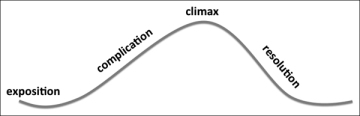
Any type of presentation is better if it has some sort of narrative. This doesn’t always mean that you have to tell a story in the traditional sense, although relating personal stories that align to your presentation’s main point can be a compelling way to gain your audience’s interest. But even if you don’t tell a personal story, you need to think carefully about the narrative arc and the beginning, middle, and end of your presentation. Let’s take a look at the narrative arc (Figure).

Figure 4-1

FIGURE The narrative arc

Your presentation needs to have a framework that creates clear markers for where the presentation begins (exposition), how and where the details that are generally in the middle are described (complication), where the turning point or lessons learned occurs, (climax), and where the presentation ends (resolution). This framework will provide it with natural structure, enabling the audience to follow you where you are going and to understand how you got there.

Consider how you will provide the background and description necessary to set the stage for your presentation. Think about the following questions:

  • What level of detail is needed?
  • How will you engage your audience’s interest in the presentation topic?
  • Is there is a complicating factor, a troubling issue, or some other tricky situation that needs resolution?
  • What is the climax that can serve as the presentation’s turning point, where your recommendations and their validity become clear?

Determining the benefit of your recommendations and how they can help successfully resolve a challenge will provide the audience with a satisfactory sense of completion that allows for a straightforward ending to your presentation.

Pull out the sentence you wrote earlier that defines what your presentation is about. This will help you create a clear narrative arc that stays on point and is connected to your topic. It will provide a strong common thread throughout your whole presentation that will ensure that all of your details, side points, or related stories back up that most important goal that you have committed to communicating to your audience.

This assignment prepares you to answer or ask questions and organize your thoughts in an outline format on an introductory speech about any aspects of your infancy, adolescence and adulthood or a combination of these.

Recall Your Infancy

  1. What were your physical surroundings like? What colors did you see?
  2. What was your life like in your family?
  3. What kind of people were your mother? Father? Sisters? Brothers? Other relatives?
  4. Who took care of you?

Recall Your Childhood

  1. What kind of clothes did you wear?
  2. Who were your friends?
  3. What did you do with your friends?
  4. What games/toys did you play with?
  5. What was your life with your family like?
  6. How did you express your feelings?

Recall Your Adolescence

  1. Who were the most important people in your life?
  2. What did you want to do when you got older?
  3. What kind of world was this?
  4. How did you express your needs and feelings?
  5. How did you relate to the opposite sex?
  6. How did you feel about yourself?
  7. How did you resolve conflicts you had with your peers? Parents? Teachers?

As an adult

  1. How important is work to you?
  2. What kind of work do you do to make money?
  3. How are you treated by your colleagues? Subordinates? Boss? How do you resolve conflicts with these people?
  4. How many jobs have you had?
  5. What job would you like to have?
  6. Do you feel that you have any value to other people?
  7. Are you married?
  8. What is married life like? How do you resolve conflicts with your spouse/
  9. Do you have any children? How do you resolve conflicts with your children?
  10. What kind of life do you think your children will have?
  11. What will their futures be like?
  12. Are you getting everything you want in your life?
  13. What do you do to get what you want?
  14. What kinds of satisfactions have you had?
  15. Does anyone know who you really are?
  16. With whom do you share leisure time activities?
  17. What kinds of disappointments or difficulties have you had?
  18. Do you feel that anyone really cares what happens to you?

NOTE: if there is any question feel free to ask because its a personal narrative

Inferential Statistics

Chose- Option 1 (Minnesota)- Have attached the Excel spreadsheet with the information, I have also attached the papers I have wrote the past 2 weeks. Please let me know if you have any further questions.

This week you will begin working on Phase 4 of your course project. For Phase 4 of your course project, you will want to review your instructor’s feedback from your Phase 1, Phase 2, and Phase 3 submissions to make any necessary corrections. Remember if you have questions about the feedback to ask your instructor for assistance.

Once you have made your corrections, you will compile your information from Phase 1, Phase 2, Phase 3 and your final conclusion into one submission and submit this as your rough draft for Phase 4 of the course project. Below is a summary of the expectations for Phase 4 of the course project:

  1. Introduce your scenario and data set.
    • Provide a brief overview of the scenario you are given above and the data set that you will be analyzing.
    • Classify the variables in your data set.
      • Which variables are quantitative/qualitative?
      • Which variables are discrete/continuous?
      • Describe the level of measurement for each variable included in your data set.
  1. Discuss the importance of the Measures of Center and the Measures of Variation.
    • What are the measures of center and why are they important?
    • What are the measures of variation and why are they important?
  1. Calculate the measures of center and measures of variation. Interpret your results in context of the selected topic.
    • Mean
    • Median
    • Mode
    • Midrange
    • Range
    • Variance
    • Standard Deviantion
  1. Discuss the importance of constructing confidence intervals for the population mean.
    • What are confidence intervals?
    • What is a point estimate?
    • What is the best point estimate for the population mean? Explain.
    • Why do we need confidence intervals?
  1. Based on your selected topic, evaluate the following:
    • Find the best point estimate of the population mean.
    • Construct a 95% confidence interval for the population mean. Assume that your data is normally distributed and σ is unknown.
      • Please show your work for the construction of this confidence interval and be sure to use the Equation Editor to format your equations.
    • Write a statement that correctly interprets the confidence interval in context of your selected topic.
  1. Based on your selected topic, evaluate the following:
    • Find the best point estimate of the population mean.
    • Construct a 99% confidence interval for the population mean. Assume that your data is normally distributed and σ is unknown.
      • Please show your work for the construction of this confidence interval and be sure to use the Equation Editor to format your equations.
    • Write a statement that correctly interprets the confidence interval in context of your selected topic.
  1. Compare and contrast your findings for the 95% and 99% confidence interval.
    • Did you notice any changes in your interval estimate? Explain.
    • What conclusion(s) can be drawn about your interval estimates when the confidence level is increased? Explain.
  1. Discuss the process for hypothesis testing.
    • Discuss the 8 steps of hypothesis testing?
    • When performing the 8 steps for hypothesis testing, which method do you prefer; P-Value method or Critical Value method? Why?
  1. Perform the hypothesis test.
    • If you selected Option 1:
      • Original Claim: The average salary for all jobs in Minnesota is less than $65,000.
      • Test the claim using α = 0.05 and assume your data is normally distributed and σ is unknown.
    • If you selected Option 2:
      • Original Claim: The average age of all patients admitted to the hospital with infectious diseases is less than 65 years of age.
      • Test the claim using α = 0.05 and assume your data is normally distributed and σ is unknown.
    • Based on your selected topic, answer the following:
      1. Write the null and alternative hypothesis symbolically and identify which hypothesis is the claim.
      2. Is the test two-tailed, left-tailed, or right-tailed? Explain.
      3. Which test statistic will you use for your hypothesis test; z-test or t-test? Explain.
      4. What is the value of the test-statistic? What is the P-value? What is the critical value?
      5. 5.) What is your decision; reject the null or do not reject the null?
        1. Explain why you made your decision including the results for your p-value and the critical value.
      6. State the final conclusion in non-technical terms.
  1. Conclusion
    • Recap your ideas by summarizing the information presented in context of your chosen scenario.

Please be sure to show all of your work and use the Equation Editor to format your equations.

Accounting Recommendations

Assume that you are the CEO of a small publicly traded company.The operating performance of your company has fallen below market expectations, which is reflected in a depressed stock price.At your direction, your CFO provides you with the following recommendations that are designed to increase your company’s return on net operating assets (RNOA) and your operating cash flows, both of which will presumably, result in improved financial performance and an increased stock price.

Directions: Evaluate each of the CFO’s recommendations.In your evaluation, consider whether each recommendation will positively impact the operating performance of your company or whether it is cosmetic in nature.Discuss if the recommendation may cause any negative consequences to the company or any ethical implications.

The response to each suggestion should be 200-300 words in length.References are required.Submit as a word document.All submissions must be made through SafeAssign.

Recommendation 1

The CFO recommends that your company reduce inventories (raw material, work-in-progress, and finished goods) and receivables (through selective credit granting and increased emphasis on collection of past due accounts) to improve net cash flow from operating activities.

Recommendation 2

To increase RNOA the CFO recommends that your company sell and lease back its office building.The lease will be structured so as to be classified as an operating lease under GAAP.

Recommendation 3

To increase net cash flows from operating activities the CFO recommends that your company lengthen the time taken to pay accounts payable.

Recommendation 4

Because your company’s operating performance is already depressed, the CFO recommends that you take a “big bath”; write off all assets deemed to be impaired and accrue excessive liabilities for future contingencies.The higher current period expense will result in higher future period income as the assets written off will not be depreciated and your company will have a liability account available to absorb future cash payments rather than recording them as expenses.

Recommendation 5

The CFO recommends that your company increase its estimate of expected return on pension investments.This will reduce pension expense and increase operating profit which will result in a higher RNOA.

Recommendation 6

The CFO recommends that your company share ownership of its outbound logistics (trucking division) with another company in a joint venture.This would have the effect of increasing throughput, thus spreading overhead over a larger volume base, and would remove the assets from your company’s balance sheet since the joint venture would be accounted for as an equity method investment.

ABS 200 Discussion Needf someone who is in the US that has access to the materia

Forensic Psychology and Research

Interact with the Forensic Psychology learning object located in the left navigation bar for this week and ensure you have finished the reading and reviewed any relevant Instructor Guidance prior to completing this discussion. Doing so will introduce you to topics in the field of forensic psychology that may provide some direction for your Library search and  assist you in finding relevant research around those topics.

Visit the Ashford University Library. Find a research study related to forensic psychology. For assistance in finding research, please visit the
Psychology Research Guide page in the Ashford University Library. Summarize the study in your initial post. In addition:  

  • Clearly identify the topic, the research questions, and why the study is of interest to you.
  • Summarize the results of the research.  Was the hypothesis supported or not? Were the research questions answered?
  • Identify ethical considerations the researchers had to consider.
  • Explain how this research impacts real-world forensic psychology. In other words, what is the practical application as you see it?

Your initial post must be a minimum of 200 words and you must utilize at least one scholarly source (e.g., the course textbook, a peer-reviewed article from the Ashford University Library, or a professional web source) that is cited according to APA style as outlined in the Ashford Writing Center. For further assistance in researching scholarly sources, please access the
tutorials on the Ashford University Library website.

Joe Judge asks you to research applicable law and to write an essay discussing

You are working as a federal law clerk in the federal court in Phoenix, Arizona. The case of Stewart v. Arizona has recently come on the docket. Stewart is currently sitting in prison in Arizona. He came to be there through the following facts:

In early 2014, a rash of seemingly related murders ravaged the area of Flagstaff, Arizona. Police soon announced that they were on the hunt for a serial killer. On March 14, 2014, Stewart retained the services of Careful and Cautious, LLP, a law firm in Flagstaff to help with his legal troubles. During the initial consultation, Stewart told James Careful the following:

Well, Mr. Careful, the truth is that I’m behind the six recent murders in the area. I’m really a good guy and I hate to kill people. But sometimes, I just can’t help myself. I don’t want to continue killing people but these voices in my head… they’re just so logical and irresistible.

James Careful promptly called the local police and reported his conversation with Stewart. Stewart was arrested for capital murder. A later search of his house turned up the murder weapon in two of the cases and files on Stewart’s computer that contained information on two more victims. Stewart was put on trial in the fall of 2014. At trial, Stewart was represented by a public defense attorney, and James Careful testified against him. Careful related the entire March 14 conversation to the jury. After a three week trial, Stewart was found guilty of six counts of capital murder and was sentenced to death. He summarily appealed his sentence. Two months ago, the Arizona Supreme Court denied his appeal.

Stewart, through his new appointed attorneys (paid for by a non-profit anti-death penalty organization), has filed a petition for a writ of habeas corpus in the federal district court for the District of Arizona. Among other arguments, Stewart claims that his rights were violated by Arizona because information and testimony was used against him that related to his confidential discussions with his then attorney, James Careful. The state claims that the use of the confidential communication with his attorney was proper in this case.

Joe Judge asks you to research applicable law and to write an essay discussing whether the use of Careful’s information and testimony regarding his conversation with Stewart violated Stewart’s rights. Mr. Judge tells you that since you’re in the 9th Circuit court of appeals’ jurisdiction, cases from the 9thCircuit would be best. However, cases from other circuits are better than nothing and can be used in a pinch.

Please prepare the requested essay.

An IRAC-style essay is appropriate for this assignment.

nO PLARGRISM

AROUND 2 PAGES

Assignment 2: Health Insurance and Quality, health and medicine homework help

Assignment 2: Health Insurance and Quality

Imagine that you are the clinic manager of an urgent care center. Recently, your center has seen an increase in complaints regarding long wait times, inadequate or incomplete information from staff during visits, and the relatively small number of insurance types accepted at the facility.

Write a two to three (2-3) page paper in which you:

1. Examine at least three (3) examples of quality initiatives that could increase patient satisfaction and potentially reduce healthcare cost. Support the response with examples of the successful application your chosen quality initiatives.

2. Defend your position on the decision to accept Medicare or Medicaid as potential pay sources for your urgent care center. Provide support with at least two (2) examples that illustrate your position.

3. Use at least two (2) quality references. Note: Wikipedia and other Websites do not qualify as academic resources. Your textbook will be the third (3) reference.

Your assignment must follow these formatting requirements:
• Be typed, double spaced, using Times New Roman font (size 12), with one-inch margins on all sides; citations and references must follow APA format. Check with your professor for any additional instructions.
• Include a cover page containing the title of the assignment, the student’s name, the professor’s name, the course title, and the date. The cover page and the reference page are not included in the required assignment page length.

The specific course learning outcomes associated with this assignment are:
• Analyze the impact of healthcare financing and health insurance on healthcare access, quality, and cost.
• Determine the factors that affect healthcare quality in healthcare organizations.
• Use technology and information resources to research issues in healthcare policy and law.
• Write clearly and concisely about healthcare policy and law using proper writing mechanics.

Grading for this assignment will be based on answer quality, logic / organization of the paper, and language and writing skills, using the following rubric.

Unacceptable Below 60% F

Meets Minimum Expectations 60-69% D

Fair 70-79% C

Proficient 80-89% B

Exemplary 90-100% A

HSA405-A2-1
1. Examine at least three (3) examples of quality initiatives that could increase patient satisfaction and potentially reduce healthcare cost. Support your response with examples of the successful application your chosen quality initiatives. Weight: 45%

Points Range: 0 (0%) – 40.48 (26.99%)

Did not submit or incompletely examined at least three (3) examples of quality initiatives that could increase patient satisfaction and potentially reduce healthcare cost. Did not submit or incompletely supported your response with examples of the successful application your chosen quality initiatives.

Points Range: 40.5 (27%) – 47.24 (31.49%)

Insufficiently examined at least three (3) examples of quality initiatives that could increase patient satisfaction and potentially reduce healthcare cost. Insufficiently supported your response with examples of the successful application your chosen quality initiatives.

Points Range: 47.25 (31.5%) – 53.98 (35.99%)

Partially examined at least three (3) examples of quality initiatives that could increase patient satisfaction and potentially reduce healthcare cost. Partially supported your response with examples of the successful application your chosen quality initiatives.

Points Range: 54 (36%) – 60.74 (40.49%)

Satisfactorily examined at least three (3) examples of quality initiatives that could increase patient satisfaction and potentially reduce healthcare cost. Satisfactorily supported your response with examples of the successful application your chosen quality initiatives.

Points Range: 60.75 (40.5%) – 67.5 (45%)

Thoroughly examined at least three (3) examples of quality initiatives that could increase patient satisfaction and potentially reduce healthcare cost. Thoroughly supported your response with examples of the successful application your chosen quality initiatives.

HSA405-A2-2
2. Defend your position on the decision to accept Medicare or Medicaid as potential pay sources for your urgent care center. Provide support with at least two (2) examples that illustrate your position. Weight: 40%

Points Range: 0 (0%) – 35.98 (23.99%)

Did not submit or incompletely defended your position on the decision to accept Medicare or Medicaid as potential pay sources for your urgent care center. Did not submit or incompletely provided support with at least two (2) examples that illustrate your position.

Points Range: 36 (24%) – 41.98 (27.99%)

Insufficiently defended your position on the decision to accept Medicare or Medicaid as potential pay sources for your urgent care center. Insufficiently provided support with at least two (2) examples that illustrate your position.

Points Range: 42 (28%) – 47.98 (31.99%)

Partially defended your position on the decision to accept Medicare or Medicaid as potential pay sources for your urgent care center. Partially provided support with at least two (2) examples that illustrate your position.

Points Range: 48 (32%) – 53.98 (35.99%)

Satisfactorily defended your position on the decision to accept Medicare or Medicaid as potential pay sources for your urgent care center. Satisfactorily provided support with at least two (2) examples that illustrate your position.

Points Range: 54 (36%) – 60 (40%)

Thoroughly defended your position on the decision to accept Medicare or Medicaid as potential pay sources for your urgent care center. Thoroughly provided support with at least two (2) examples that illustrate your position.

HSA405-A2-3
3. Two (2) References Weight: 5%

Points Range: 0 (0%) – 4.48 (2.99%)

No references provided

Points Range: 4.5 (3%) – 5.24 (3.49%)

Does not meet the required number of references; all references poor quality choices.

Points Range: 5.25 (3.5%) – 5.98 (3.99%)

Does not meet the required number of references; some references poor quality choices.

Points Range: 6 (4%) – 6.74 (4.49%)

Meets number of required references; all references high quality choices.

Points Range: 6.75 (4.5%) – 7.5 (5%)

Exceeds number of required references; all references high quality choices.

HSA405-A2-4
4. Clarity, writing mechanics, and formatting requirements Weight: 10%

Points Range: 0 (0%) – 8.98 (5.99%)

More than 8 errors present

Points Range: 9 (6%) – 10.48 (6.99%)

7-8 errors present

Points Range: 10.5 (7%) – 11.98 (7.99%)

5-6 errors present

Points Range: 12 (8%) – 13.48 (8.99%)

3-4 errors present

Points Range: 13.5 (9%) – 15 (10%)

0-2 errors present